




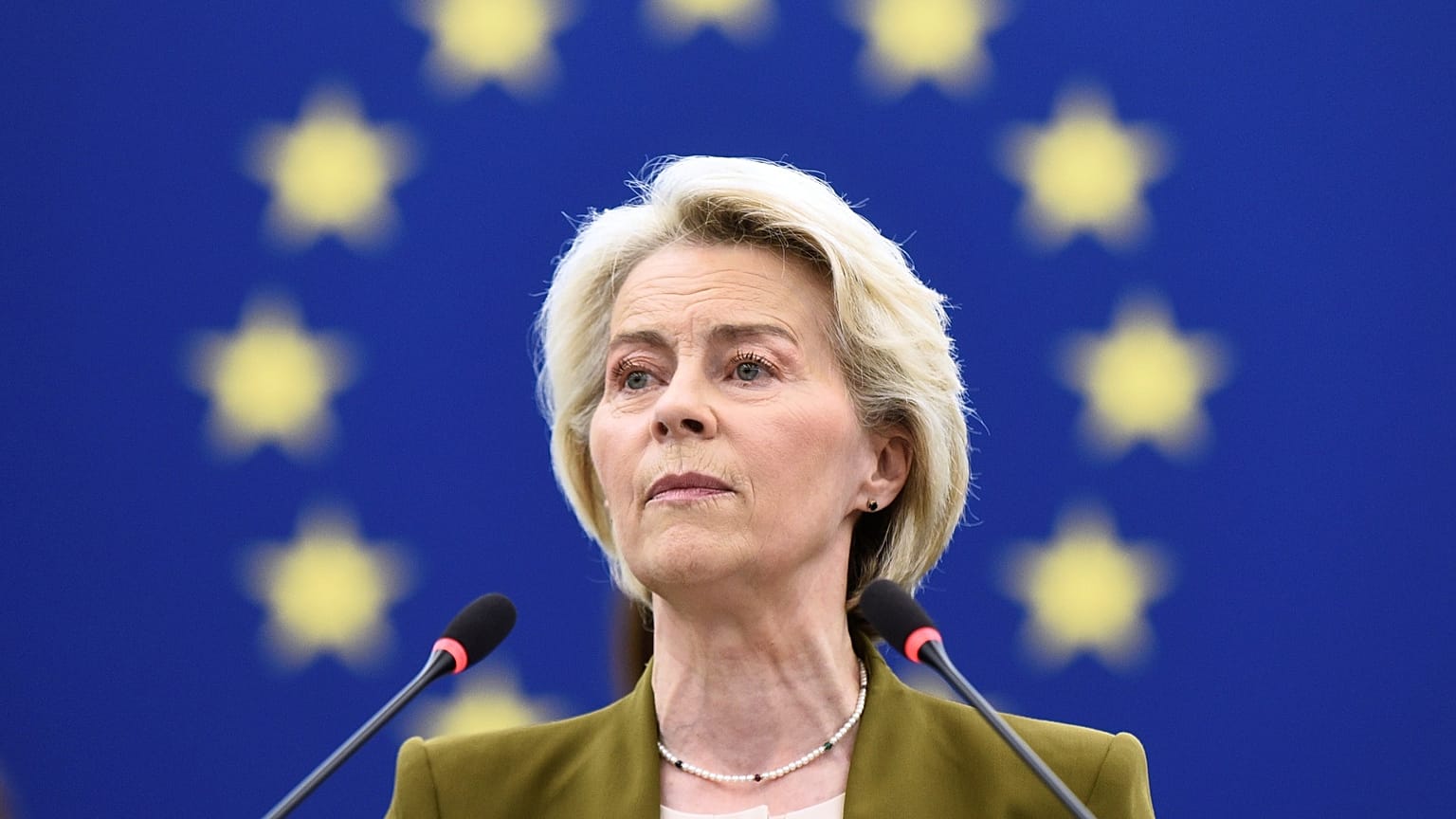












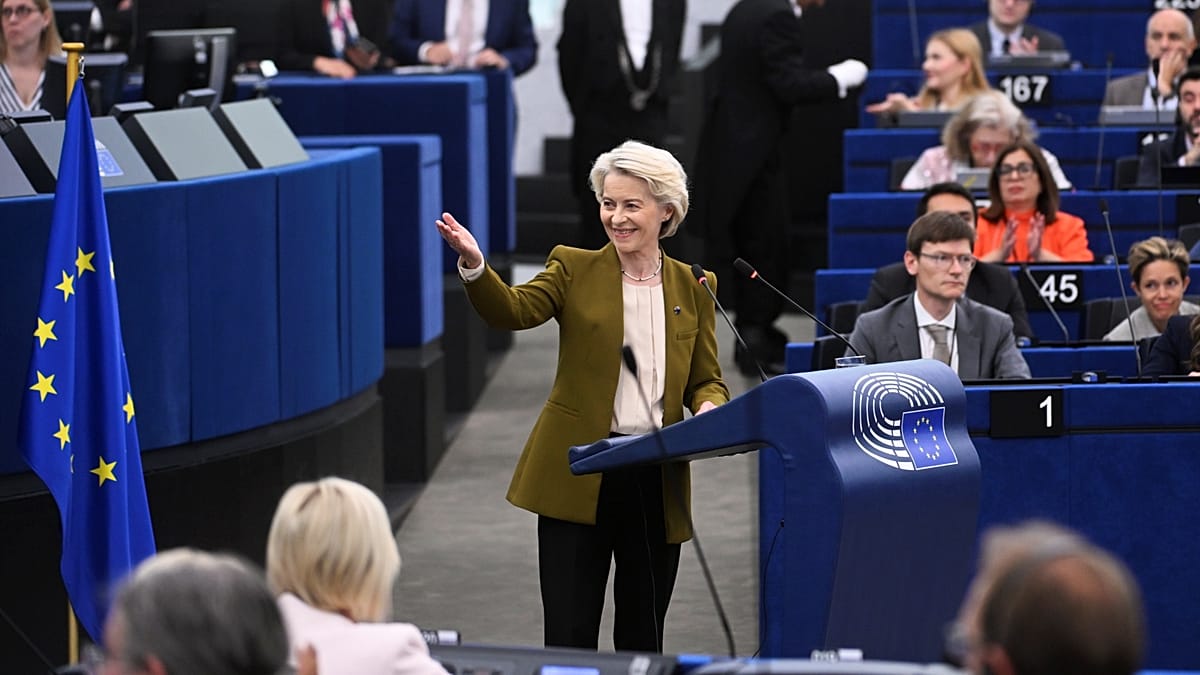
Im Liveticker: Ursula von der Leyen hält die jährliche Rede zur Lage der Union vor dem Europäischen Parlament in Straßburg.
Ursula von der Leyen, Präsidentin der Europäischen Kommission, wird in Straßburg in Frankreich ihre jährliche Rede zur Lage der Europäischen Union halten.
 WERBUNG
WERBUNG
WERBUNG
Die umfassende Ansprache vor dem Europäischen Parlament soll die politische Agenda des kommenden Jahres abstecken, neue Initiativen skizzieren und die zahlreichen Herausforderungen beleuchten, vor denen die EU intern und extern steht.
Der Krieg Russlands gegen die Ukraine, die Erweiterung der Union, der Klimawandel, irreguläre Migration, soziale Medien, der Handel mit China, Sicherheit und Verteidigung sowie die Arktis werden voraussichtlich zentrale Themen der Rede sein.
Kanadas Premierminister Mark Carney wird als Ehrengast im Plenarsaal anwesend sein, wenn von der Leyen ein vertieftes Kapitel in den Beziehungen zwischen der EU und Kanada vorstellt. Carney wird am folgenden Tag eine eigene Ansprache halten, an der von der Leyen teilnimmt.
Verfolgen Sie den Euronews-Liveblog auf Englisch.

 ${title}
Live beendet
Our five takeaways from the speech
The State of the Union speech is over, and so is our live blog.
Thank you so much for spending the morning with us.
We leave you with our selection of the five takeaways.
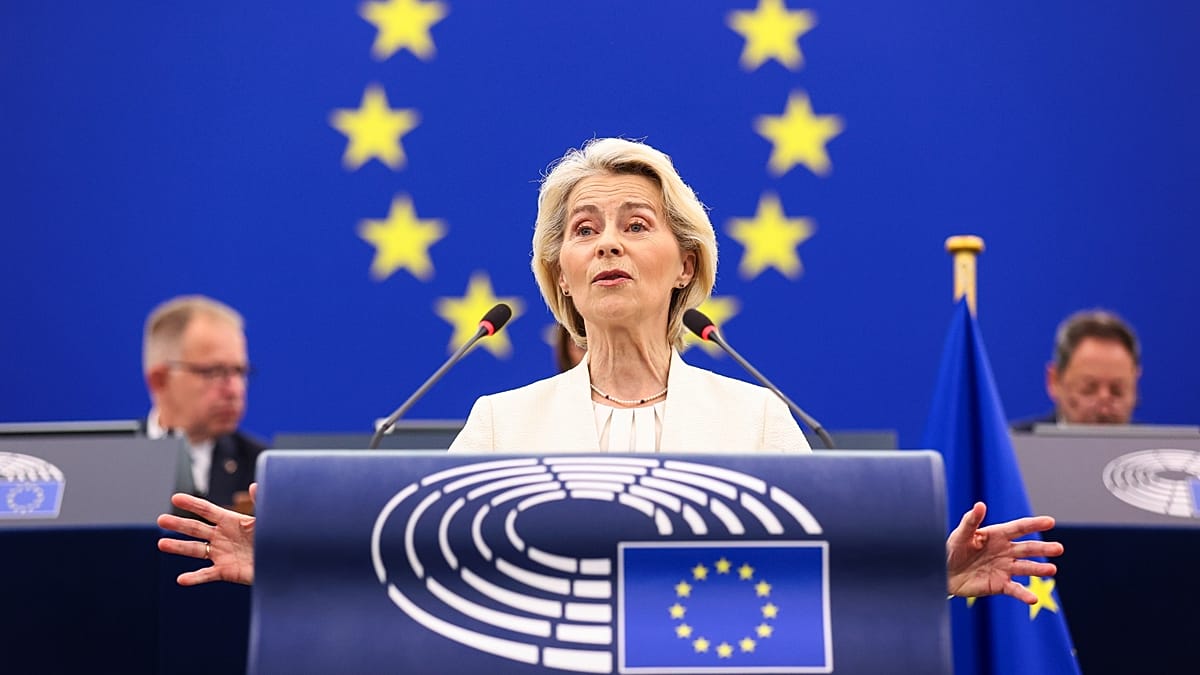
State of the Union: Five takeaways from Ursula von der Leyen’s speech
Canada, hybrid warfare, climate change, digital safety and migration were front and centre at Ursula von der Leyen’s State of the Union speech. #EuropeNews
Von der Leyen leaves the hemicycle
Roberta Metsola, the president of the European Parliament, has closed the debate on the State of the Union. Ursula von der Leyen has left the chamber. Parliament will now resume ordinary legislative work.
'Let's work together,' von der Leyen tells MEPs as she calls for strong EU budget
Ursula von der Leyen gave her final reply by calling on the "pro-European" forces of the Parliament to close ranks and work together.
"Let's stand together, let's work together, let's make a strong and independent Europe together," she said.
In her intervention, she put special emphasis on the next seven-year EU budget, which is currently subject to intense negotiations. Her €2 trillion proposal has been welcomed by the Parliament but faces strong resistance from some member states, such as Germany, the Netherlands, Austria and Sweden, who are demanding across-the-board cuts. The Parliament, by contrast, advocates an expansionary vision.
"The answer lies in a strong European budget," she said. "I'm preaching here in the wrong church. I know it. But I'll say it again: we have to get the budgetary equation right."
Von der Leyen stressed the need to approve new own resources – in essence, EU-wide taxes – to raise additional revenue to complement the national contributions, which capitals are reluctant to increase. The Commission has proposed five own resources, while the Parliament has put forward an extra three.
"I know you're allies on that," she told lawmakers.
Credit: European Union, 2026.
Von der Leyen remembers assassinated journalist Daphne Caruana Galizia
In her closing remarks, von der Leyen paid tribute to Daphne Caruana Galizia, a Maltese investigative reporter who was active in exposing corruption in the country. She was murdered by a car bomb nine years ago and has since become one of the symbols of press freedom in Europe.
“No impunity for Daphne’s murder,” the Commission President said, to applause from MEPs, describing as “disheartening” the fact that Maltese justice has yet to hold anyone responsible for her assassination.
Earlier this month, a Maltese court acquitted tycoon Yorgen Fenech of orchestrating the car-bomb killing, sparking outrage among her family and widespread protests across the country.
Watch: Von der Leyen pitches 'associate membership' for Canada
Finland's prime minister welcomes pitch for a 'European Security Council'
Finnish Prime Minister Petteri Orpo has welcomed von der Leyen's proposal to establish a "European Security Council", a new body that would working together on security with likeminded partners such as Ukraine, the UK, Norway and Canada.
Orpo also backed von der Leyen's proposal for a so-called EU "Article 4", an emergency security protocol similar to NATO"s Article 4 which could be triggered by a member state requiring a coordinated European response to a threat.
"With it, EU countries could act together when a member state is subjected to a serious hybrid measure," Orpo wrote on social media.
Analysis: After last year's fiasco, von der Leyen avoids Russian assets
Surprisingly, Ursula von der Leyen made little mention of Ukraine's growing budget needs, which Russia's escalatory tactics and the blockade of the Black Sea worsen by the day.
Kyiv's shortfall has raised alarms among European capitals, some of which are pushing to revive the idea of channelling the immbolised Russian assets into a fresh line of support.
Von der Leyen knows a thing or two about the Russian assets: she proposed using them at last year's State of the Union speech. Her so-called "reparations loan" instantly met the furious resistance of Belgium, which holds the majority of the assets and feared catastrophic consequences. Her bold plan collapsed four months later, dealing a heavy blow to the Commission chief's standing. Some diplomats accused her of having failed to read the room before making a move without precedent in modern history.
It seems that this time, she's treading with extra caution before daring to reopen Pandora's box.

Russian assets not the focus now, Brussels says as calls grow louder
The European Commission is not willing to reopen the contentious debate on the immbolised Russian assets, at least not without a guarantee of success. “Now, th…
ECR pushes hard on critical raw materials and EU-Canada relationship
“The main problem we should be addressing today is not CO2, but the lack of critical raw materials,” European Conservatives and Reformists leader Nicola Procaccini stated in his intervention during the State of the Union debate.
"Without them, there can be no green or energy transition."
He challenged von der Leyen’s “obsession” for decarbonisation of the European economy, pointing out that the EU is forced to buy critical raw materials from hostile regimes.
Procaccini was also critical of von der Leyen “bowing to Prime Minister Carney”, as he put it.
“How is it possible that the United Kingdom does not have priority when it comes to becoming an associate member?” he asked.
Greens' Diana Riba urges more power for municipalities and regions
Green Vice-Chair Diana Riba reminded Ursula von der Leyen of a letter signed by more than 650 local elected representatives from many European regions, saying they're calling for the European budget and European policies not to be held in the hands of member states.
"We've seen how the European Union seems to be a union of member states, but let's recall that it's not states, but municipal areas and regions," she said. "And when people feel they're not being listened to, then things happened, such as the result in Saxony-Anhalt, Catalonia, Galicia, Valencia, the Balearic Islands, Brittany, Corsica and many other regions ready to build Europe."
The Left calls for taxing oil companies’ profits
Manon Aubry, leader of The Left group, called for a tax on oil companies’ profits in a strongly critical intervention during the State of the Union debate.
“What are you waiting for to cap prices and tax the windfall profits of oil companies such as Total, which have quadrupled their margins? For petrol to reach €3 a litre?” she asked Ursula von der Leyen, accusing her of being “obsessed with competitiveness.”
Aubry also criticised some of von der Leyen's pitches, such as the proposal to make Canada the EU's first "associated member" and creation of a European Security Council.
"Who gave you a democratic mandate for this?" she asked, referring to Canada.
Securing EU long-term budget is a priority for the Irish presidency, Byrne says
Finding a deal on the EU long-term budget (2028-2034) is a priority for the Irish presidency, Irish Minister for European Affairs Thomas Byrne said on Wednesday.
Ireland is currently chairing the negotiations among the member states on the matter until December 2026.
Renew Europe chair: EU must take lead on regulating AI
“We need to take global leadership in establishing a legal framework for AI, as we did with nuclear power,” said Renew Europe chair Valérie Hayer, claiming it is up to political leaders to “to set a philosophical limit on the development of artificial intelligence.”
Hayer also praised Canadian Prime Minister Carney for his stance towards US President Donald Trump.
"You have shown what needs to be done: refuse to compromise, hit back, protect your interests, speak the language of power,” she said.
Greens are ready to push for a windfall tax on energy profits
As energy companies continue to profit from Europe’s extraordinary energy crisis, Greens leader Terry Reintke said her party would keep pushing for a windfall profits tax, arguing that polluters, rather than consumers, should bear the cost. Her remarks echoed those of her Socialist counterpart.
She also urged von der Leyen to show some pragmatism in the upcoming climate adaptation plan, with the "necessary funds" attached in the MFF, the bloc's multi-annual budget for the next 8 years.
"A climate adaptation plan that actually makes us better prepared for the next time," Reintke said.
'Where was Merz when Europe was burning?', Greens' leader said
Green leader Terry Reintke recalled the “absolutely devastating summer” and said the fundamental question now is how and where the Commission, President von der Leyen and European leaders will take action.
"Where were you, President von der Leyen, when more than 650,000 hectares of forest burnt in Europe this summer? Where was Friedrich Merz (Germany's Chancellor) when grain farmers in Europe lost around 2 billion in revenue in a heat wave in June? Where were European leaders when 35,000 Europeans died?"
Greens' leader announces inquiry committee over Green Deal's lack of enforcement
"We have to stop this deregulation, the attacks on the Green Deal, but we have to investigate why the European institutions were so weak in enforcing the Green Deal," Terry Reintke said in Strasbourg.
"And that is why my group is going to ask for an inquiry committee into the shortcomings of executing what we had already decided in the European Union in the Green Deal."
Bardella attacks von der Leyen, calls for European preference in public procurement
Far-right Patriots for Europe leader Jordan Bardella called for a European preference in public procurement during his intervention during the State of the Union debate.
“When the money is European, the jobs should be European,” he said.
Bardella also criticized von der Leyen, claiming EU policies had made life more expensive for European citizens and failed to protect them from external threats.
“A Europe without walls is destined to disappear,” he said, referring to the large influx of irregular migrants into Ceuta last July.
Key takeaways from von der Leyen's speech
Here are the key takeaways from von der Leyen's hour-long speech:
- A European-wide plan to manage heatwaves
- A Climate Insurance Alliance to protect against extreme weather
- A Security Council with Ukraine, the UK, Norway and Canada
- A NATO-like mechanism to respond to hybrid attacks
- The EU Kids Act to restrict access to social media for children under 15
- A coalition of like-minded partners to monitor frontier AI systems
- An emergency framework to cope with mass arrivals of irregular migrants inspired by the Ceuta border crisis
- A European Care Deal to address the demographic challenges
- "Associate membership" for Canada, a status without precedent
European People's Party fighting for a stronger MFF, Weber says
The centre-right European People's Party (EPP) is fighting for a stronger Multiannual Financial Framework (MMF), the EU long term budget for the period 2028-2034, EPP President Manfred Weber said on Wednesday.
Weber outlined his priorities for the budget: improving the bloc's competitiveness while ensuring that traditional priorities such as fisheries, agriculture and regional funds do not face drastic cuts.
The EPP president sent a message to some EU countries, led by Germany and The Netherlands, that want to substantially cut the budget, in particular on traditional expenditures.
"Stop being populistic, tell us where you would like to cut," he said.
Member states are currently negotiating the budget, expected to be approved by the end of the year.
Socialist leader calls for windfall tax on energy companies
The leader of the centre-left Socialists and Democrats (S&D) group, Iratxe García Pérez, the second largest in the European Parliament, proposed introducing a windfall tax on energy companies to finance a social support scheme.
“Trump and Netanyahu's war against Iran has strengthened the ayatollahs and sent the cost of living soaring. Let's accelerate renewables. And let's get those who benefit from this crisis to contribute,” she said.
García said the contribution would be used to help fragile households pay their electricity bills, fill their shopping carts, put petrol in their cars and heat their homes.
EPP will push against the ban on combustion engines, Weber says
The European People’s Party will push for a “reasonable” reform of the EU Emissions Trading System (ETS) and seek to halt the planned ban on combustion-engine cars, EPP leader Manfred Weber said during his intervention at the State of the Union debate.
The European Parliament’s largest political group is determined to roll back one of the Green Deal’s key measures aimed at achieving climate neutrality by 2050.
Weber acknowledged that climate change “is a reality” but argued that it should not lead to restrictions on combustion-engine vehicles.
“We need innovation, not bans,” he said.
Von der Leyen finishes her speech
Ursula von der Leyen has concluded her State of the Union speech, which stretched for over one hour.
Now, the leaders of each group in the Parliament take the floor in order of representation.
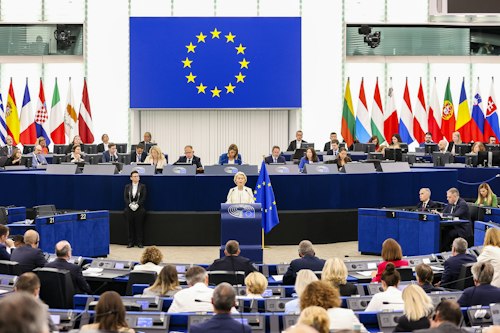
Credit: European Union.
Von der Leyen announces new ‘Congress of Europe’
Commission President announced a new European Congress to celebrate the 70th anniversary of the Treaty of Rome next year.
“We will launch a new Congress of Europe. Bringing together the greatest thinkers and writers, artists and scientists, citizens and civil society,” she said.
“We need our brightest minds — from across our Union and our whole continent. Together, they will develop a vision capable of inspiring the new generation of Europeans. Capable of reclaiming our European imagination. So that the next generation can write its own history,” von der Leyen added.
She hailed it as a generational exercise as a way to refresh the European project and continue building a “common destiny.”
Von der Leyen 'horrified' by Ratko Mladić's funeral
The Commission President has said she was "horrified" by the funeral of convicted war criminal Ratko Mladić in Belgrade earlier this month, adding that the "glorification" of war crimes has "no place" in the European Union.
But she stopped short of announcing any retaliatory measures against the Serbian government, which has been accused of allowing Mladić to be buried with state honours.
Government ministers were present at the funeral, while Mladić's body was transported from The Hague -- where he was serving a life sentence at a UN detention facility -- in a government airplane, draped in the Serbian flag.
The EU's enlargement chief, Marta Kos, postponed an upcoming visit to Belgrade in response while diplomats have told Euronews the incident will likely prevent EU capitals from advancing Serbia's bid to become a member of the bloc.
Von der Leyen is widely expected to travel to all Western Balkan EU candidate countries, including Serbia, in the autumn. While the Commission says the programme for that trip has not yet been defined, many lawmakers had been calling on von der Leyen to follow Kos's lead by cancelling her planned visit to Belgrade.
Full house for the speech
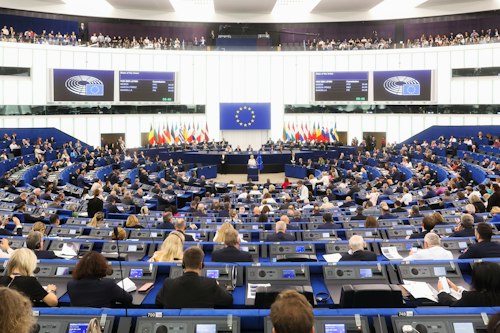
Credit: European Union
EU Kids Act will restrict social media access, addictive features
The Commission will propose an EU Kids Act on Thursday with a gradual approach to protect children online, banning access for users younger than 13 years old and restricting access for under-15s.
“We do not have to accept addictive features. We do not have to accept children being drawn into ever more extreme content. We do not have to accept that girls have their photos used for AI-generated sexualised images,” von der Leyen said.
The Commission chief also announced the reversal of the burden of proof, meaning it will be on tech platforms to demonstrate that they have actually made their services safe.
“Europe has the power to act. It is us who decide our rules, not big tech,” she added.

Leak: EU Commission to pitch social media restrictions for under-15s
The European Commission will propose barring under-15s from social media without parental consent, plus safety-by-design rules for risky online services like A…
Unspent defence loans will fund joint projects with Ukrainian companies
Commission President announced that the unspent funding under the Security Action for Europe (SAFE), which provides low-interest loans for boost Europe’s defence spending, will be invested in joint European-Ukrainian defence projects.
Between €10 and €15 billion have been left unspent under SAFE as several member states eventually decided to reduce their initial commitments. Until now, it was not clear how the remaining loans would be made available.
For von der Leyen, the idea is to follow the example of Freyja, a modular missile defence system Europeans and Ukrainians are working on to boost Kyiv’s air defence at a time when Russia is intensifying its airstrike campaign.
“Here we bring together Ukraine's combat experience and innovative strength with Europe's technological leadership. And, of course, our substantial production capacity. And Freyja is only the beginning. More is needed,” she said.
Von der Leyen push to maintain rule of law conditionality in long-term EU budget
EU funds must be conditional to the respect of the rule of law and fundamental rights, European Commission President Ursula von der Leyen said during her State of the Union address in the European Parliament in Strasbourg.
"With the next long-term budget we must go even further. Respecting the rule of law and fundamental rights is a must for European funds. It has to be front and centre in the budget. Now and in the future," Von der Leyen said during her speech
The European Union is negotiating its long-term budget for the period 2028-2034. Member states are working on expenditures, priorities, as well as potential new taxes.
As for the current budget, the European Commission is pushing to maintain the rule of law conditionality.
Von der Leyen: Hungarians 'chose democracy, chose Europe' in April election
Ursula von der Leyen praised the outcome of Hungary's parliamentary elections in her State of the Union speech, saying voters had brought Hungary back to the heart of the European Union.
Such open commentary on a national election result is rare for the European Commission, underlining the significance Brussels attaches to the change of government in Budapest.
In April, Péter Magyar's centre-right Tisza Party won a landslide victory, ousting Viktor Orbán's eurosceptic government after 16 years in power. Magyar was sworn in as Hungary's prime minister in May.
"Nothing is inevitable. Just look at Hungary," von der Leyen said.
"The 12th of April will stay in our memory for a very long time. The day Hungarian people took their future in their hands. They chose democracy. They chose Europe. They brought Hungary back to where it belongs: at the heart of our Union."
Hungary had previously faced financial sanctions over concerns about systemic corruption and the rule of law. Orbán also came under strong criticism in Brussels over his close ties with Russia and his repeated blocking of EU support packages for Ukraine. Von der Leyen said Prime Minister Péter Magyar had stepped up efforts to tackle corruption and state capture.
"Years of backsliding have started to be reversed. The fight against corruption and state capture is speeding up. There is real progress on fundamental rights, on academic freedom. And now, billions of euros of investment in Hungary have been unlocked."
In May, Magyar and von der Leyen agreed on the release of €16.4 billion in previously blocked funds. If Hungary meets all the required criteria, the money could arrive in Budapest later this year.
Migration: Frontex to play a role in returning irregular migrants
The European Commission will strengthen Frontex, the EU border agency, “especially to speed up returns” of irregular migrants, von der Leyen said.
In 2024, she pledged to triple Frontex’s staff to as many as 30,000 officers. She now appears to be proposing a reform of the agency’s mandate, giving it a more proactive role in tackling irregular migration.
The Commission chief said the agency will improve its early warning systems to ensure it can detect and anticipate large-scale migratory movements, while stepping up its cooperation with non-EU countries.
“It is us, Europeans, that decide who comes to our Union and under what circumstances. And not the smugglers and the traffickers,” she said.
Migration: von der Leyen pitches an “emergency framework” to address Ceuta-like crises
Ursula von der Leyen announced a new “European Emergency Response Framework,” to be triggered under a strictly defined set of criteria in the event of a sudden, large-scale influx of irregular migrants, as happened in the Spanish exclave of Ceuta last July.
“The events of this summer show that our tools need to evolve — especially for emergency situations,” von der Leyen said, arguing that the EU needs the means to protect its borders, especially when “mass movements are engineered and weaponised.”
The framework would allow for temporary flexibility in standard procedures, which, according to EU sources, could translate into a temporary suspension of the right to asylum.
Russia's attacks on Ukraine are 'deliberate strategy of terror', says von der Leyen
Von der Leyen denounced Russia's escalation against Ukraine, which has seen jet-powered drones and ballistic missiles hitting civilian infrastructure indiscriminately. The rampant destruction has only added to Ukraine's growing financial needs.
"Every day this summer, strike after strike hit Ukrainian cities," von der Leyen says.
"In Odesa, Russian drones struck a crowded shopping mall in broad daylight. Then they struck a second time — deliberately targeting the rescue workers who rushed in to help," she adds.
"This is not just war. This is a deliberate strategy of terror."
Von der Leyen recognises ‘painful’ lack of action on Gaza, but offers no new measures
The Commission President has acknowledged that it’s “painful” for many Europeans that EU countries have been unable to “build the necessary majorities” for a unified response to Israel’s war in Gaza.
In last year’s speech, von der Leyen surprised the chamber by proposing a partial suspension of the EU’s trade pact with Israel – the Association Agreement –, as well as sanctions on extremist ministers of the Israeli government and on violent settlers in the West Bank.
Only sanctions on settlers have been approved, with the other measures failing to secure the necessary support among member states.
Last week, several European countries, led by the UK, went further by suspending trade with Israeli settlements in the occupied Palestinian territories, another measure EU member states have failed to agree on.
Describing Israel’s settlement expansion “unacceptable”, von der Leyen acknowledged that some EU countries were moving ahead to introduce their own measures in the absence of EU consensus.
'I invite Canada to be the first associate member of the EU,' von der Leyen says
European Commission President Ursula von der Leyen has called on Canada to become the first "associate member" of the EU.
As Canada is not a European state, it cannot become a full member of the EU according to the EU treaties. So EU officials have been searching lately for other options.
On Wednesday, von der Leyen gave Ottawa the status of "associate member."
"I invite Canada to be the first associate member of the EU," von der Leyen said.
But it remains to be seen what this involves concretely. However the political signal sent to the world is strong: Both Brussels and Ottawa seem ready to deepen their relationship.
Pressure on Russia 'must keep increasing', says von der Leyen
"The pressure on Russia must keep increasing. This does not always require new sanctions, but above all, the enforcement of existing ones," von der Leyen says, speaking in German.
"Our sanctions are painful. They put the Russian economy under enormous pressure. Russia is trying everything to circumvent them. So we must close every loophole."
It seems the wait for the 22nd package of sanctions will continue.
Von der Leyen pledges support for Ukraine 'through the hardest winter of the war'
Von der Leyen says the EU will continue its support for Ukraine to endure what is expected to be "the hardest winter of the war", including with humanitarian aid and energy system repairs.
"We will strengthen Ukraine's air defence. Last week, for the first time, we agreed for the first time on the purchase of American Patriot defence missiles. These now urgently need to be delivered," she says, referring to the military assistance provided through the €90 billion loan.
"But we must also work together to reduce our dependency on a single supplier. That is why we want to develop an affordable and modular missile defence system together with Ukraine."
The project, called Freyja, is still in early stages and aims to develop a European-made alternative to the US-made Patriots, whose demand has skyrocketed in recent years, leading to severe production backlogs.
"And Freyja is only the beginning. More is needed," she says.
European Security Council must become a 'reality', von der Leyen vows
Von der Leyen just said that European peace is threatened while Russia’s war of aggression rages on, with threats “mounting on our soil” are mounting — and “ramping up every day”.
“The attempted drone attack in Leipzig is the latest proof. We need to be clear about what this was — an attack using military-grade material, carried out by Russian operatives on European soil,” she said.
“An attack not only on one member state — but against all our Union. And honourable members, we will not allow it.”
To meet these challenges, Europe needs its “own counter-hybrid playbook.”
“We urgently need consensus on how to respond to certain incidents. Those which fall below armed aggression but clearly threaten our national security. In other words, a mechanism to flank NATO’s Article 4,” she said.
Von der Leyen is here referencing the NATO instrument which allows any country from the 32-member group to call an emergency meeting to discuss a security threat. It is the precursor to Article 5, which is an attack on one being an attack on all.
“When triggered by one member state, all member states would convene to coordinate a European response,” von der Leyn said about the proposed mechanism.
“To deter further escalation and to mitigate the impact.”
She went one step further by stating that a European Security Council must become a “reality”.
A new format involving allies — such as Ukraine, the United Kingdom, Norway, Canada and others involved — must be created in the face of the “urgent” defence needs required, von der Leyen vowed.
“The urgency is clear. And the principle is simple: Europe’s security is indivisible,” she said.
‘Women are here to stay,’ von der Leyen says, pushing back on rights challengers
The fight for equal treatment and opportunities for women cannot be allowed to go backwards or return women to a time when they were treated as second-class citizens, von der Leyen said during her State of the Union address.
"Today, our fundamental values are being challenged. Some people even want to backslide on women's rights. To send us back to an age in which women were second-class citizens," von der Leyen said.
"Women are here to stay. We will defend our rights. And we will continue to stand up for our values every single day," the president said.
Von der Leyen announces ‘game-changing initiatives’ for industrial AI
Von der Leyen announced that in November the Commission will invite European governments, MEPs and industry players to join an ambitious new European project on industrial AI applications in five strategic sectors.
“We are now focusing on five of the highest value sectors where industrial AI has the biggest potential: health, transport, agri-food, advanced manufacturing, and defence and space,” she said.
For the Commission chief, Europe has an important role to play when it comes to reaping the added value of AI applications, citing factories, hospitals, agriculture, energy grids, defence and autonomous driving as cases in point.
“This is where the real value is hidden. And it is where Europe has big advantages. We have world-class industries that sit on the highest quality data. These data are a precious European treasure. They are — what can power tailor-made Industrial AI models,” von der Leyen continued.
She also stressed that the idea is to improve human-made decision-making rather than replace it. “We must do it in a European way,” she said.
Long tribute to Danish firefighter who died on a mission
The European Parliament paid a long and emotional tribute to Danish pilot Rune Kyndal, who died in Greece alongside his fire liaison officer while battling a wildfire.
Von der Leyen mentioned his story as an example of the firefighters and crews who have saved lives and homes across Europe this year.
“Kyndal became one of Canada’s most experienced civilian pilots, but he came back to Europe to help tame wildfires across our continent,” von der Leyen recalled.
Last July, after many successful missions in Greece, he was supposed to take a break.
“But the emergency was at its peak. So Rune decided to stay. A few days later, he was involved in a tragic accident with his fire liaison officer. Both Rune and the officer were killed. They died as heroes,” the Commission President said.
All MEPs stood for a prolonged and heartfelt round of applause in his memory, as a photograph of Kyndal was displayed in the hemicycle.
‘We will move from CETA to an Alliance for the Future’
European Commission President Ursula von der Leyen has called for a new alliance with Canada, which has been seeking closer ties with the EU since the US trade war began in late August.
“We will move from CETA to an Alliance for the Future. To create a common prosperity and economic security space.”
CETA is a trade agreement clinched in 2016 by both partners which removes tariff barriers between both sides and as been provisionally applied.
Canadian Prime Minister Mark Carney, who is attending von der Leyen’s speech, called in late August to deepen trade and security relations with the EU.
Von der Leyen added that the Alliance could include a “tech alliance” and “defence industrial base”, “an Arctic joint project,” but also work on “energy, critical minerals and batteries” and “on AI, quantum, cyber and economic security.”
The European and Canadian leaders will meet later in October during a summit in Montreal, where all those issues might be on the agenda.
An ambitious long-term budget needs own resources, von der Leyen says
The EU long-term budget 2028-2034 needs new EU taxes, von der Leyen said during her speech at the European Parliament in Strasbourg on Wednesday.
An ambitious budget need "own resources," the president said during her speech.
EU countries are now negotiating the budget and new EU taxes, known as own resources, are under negotiations. Net payers countries, such as Germany, are sceptical over own resources.
Negotiations are expected to be concluded by the end of the year.
European firms need conditions to scale up with capital markets and banking sector reform
Europe needs to create the right conditions for companies to thrive, including better access to capital and a banking sector that is more supportive of cross-border operations. These are two key reforms the EU is pursuing to help European businesses scale up and compete globally.
"We must create the conditions for our companies to attract investments and grow. This is why our work on the Saving and Investments Union is so critical," European Commission President Ursula von der Leyen said during her speech.
The Saving and Investment Union (SIU) is a package of reform that aims to reduce fragmentation of European capital markets, places where companies can get credits and investors can invest.
The SIU is currently under negotiation in Brussels.
In parallel, von der Leyen advocates for the reform of the banking sector. "We need a banking system that is built for growth - not just stability," von der Leyen said.
In mid-July, the European Commission put forward a banking sector report to make it easier for banks to work cross-border and reducing fragmentation. A legislative proposal is expected to be presented next year.
Von der Leyen announces European Care Deal, recalls Affordable Housing
The upcoming European Care Deal aims to address the challenges posed by demographic change, the Commission chief said, as she marked the 10th anniversary of the EU’s European Pillar of Social Rights.
"Our society has changed. In many ways for the better, in others not," von der Leyen said.
She also mentioned the recently proposed first-ever Housing Act to tackle short-term rentals and housing speculation.
"Care is not a privilege. Housing is not a privilege. They are rights," von der Leyen said.
Von der Leyen calls for pacing the development of frontier AI models
During her speech, von der Leyen hailed AI’s potential to benefit humanity, provided possibilities and risks were correctly balanced.
“As the frontier models become more capable, these risks have come sharper into focus. Models being developed will allow hacking on a level we never thought possible. And they will soon be in the hands of adversaries who see the world very differently to us,” she said.
The Commission President mentioned the recent incidents that saw AI agents escaping their environment and independently hacking other systems, as was the case with the OpenAI-Hugging Face incident.
“CEOs of the most advanced companies tell us that it is time to slow down on the self-recursive models. To pace the frontier. If the people developing the technology are clear, then we should be too,” von der Leyen continued.
The EU already has one of the most comprehensive laws regulating Artificial Intelligence in the world, the AI Act, which gives the Commission supervisory powers over risk mitigation measures put in place on the most advanced AI models.
“We will step up together with our like-minded partners like Canada, the UK and others. We want to team up on model evaluation, verification, early-warning, AI security and much more,” she added.
The Commission chief also announced she will organise a discussion with leading AI labs on how public authorities can support industry efforts to pace the frontier of this disruptive technology.
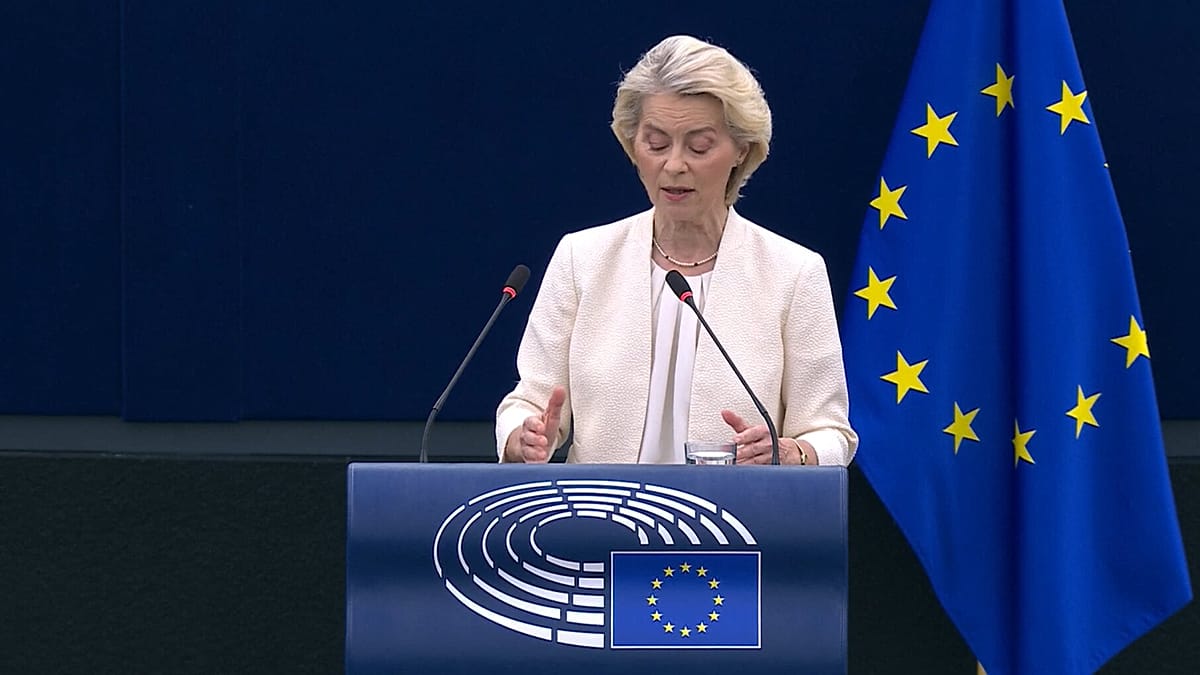
Von der Leyen calls for pacing frontier AI models
In her State of the Union address, von der Leyen called for pacing the development of frontier AI models due to their disruptive potential, pledging closer saf…
Von der Leyen pushes for the simplification agenda
Europe needs to move faster and cut red tapes with a simplification package the European Commission is undertaking.
"In today's economy, speed is of the essence. A permit or a form, a grid connection or financing decision. All of this can determine where an investment is made. Where jobs are created. We need to move much faster," European Commission President Ursula von der Leyen said during the State of the Union speech on Wednesday.
"You know that our 12 omnibus proposals are reducing administrative burden by around €17 billion a year," von der Leyen added, referring to the European Commission simplification agenda.
Water protection is back on the table, von der Leyen says
The Commission President announced a new European Water initiative — an initiative that could prove to be one of Europe's most consequential adaptation challenges.
"Crops need water to grow; livestock need it to survive. Entire harvests depend on it. This is why we will make proposals to improve risk management and address the insurance gap," von der Leyen said.
Von der Leyen unveils European Heatwave Plan
The European Commission will present a "European Heatwave Plan" after record heat, wildfires and increasingly intense weather exposed the vulnerabilities of the bloc, with scientists saying Europe is the fastest-warming continent.
"There can be no repeat of this summer. This is why we will also soon present a European Heatwave Plan. We need better early warning systems and better health preparedness. We need urban adaptation and cooling. And we need to support the most vulnerable," von der Leyen said.
Von der Leyen recognises that climate adaptation is becoming an immediate economic and public-policy challenge rather than a long-term environmental issue.
Von der Leyen announces new Climate Insurance Alliance
After a dramatic summer with intense heatwaves, thousands of hectares lost to wildfires and nuclear power plants closing in Hungary and Romania due to lower water levels in the Danube, von der Leyen touted a new Climate Insurance Alliance.
"Today, only around 25% of catastrophe losses in Europe are covered by private insurance. This means that, far too often, national budgets become the insurer of last resort.
We need to take action to close this gap," the Commission chief told MEPs in Strasbourg.
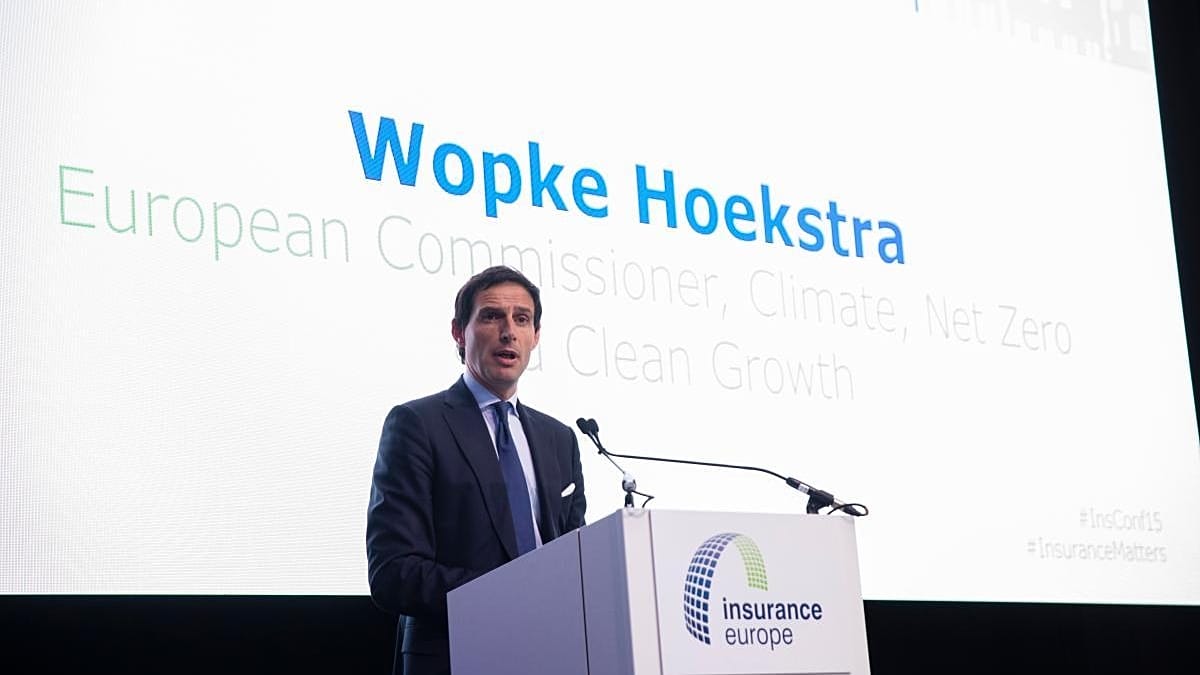
‘Europe's climate and security challenges are inseparable': Hoekstra
In an exclusive Euronews interview, Hoekstra argues climate resilience, energy security, and geopolitical independence are now inseparable. EU gas storage rema…
VDL recalls upcoming climate resilience plan
"We will present a new framework for climate resilience next month. We will identify 100 of the most vulnerable territories in Europe. And we will assess the risks — and at which level they should be managed," the Commission chief recalled as 660,000 hectares were burnt to the ground and roughly 12 million tonnes of crops were lost.
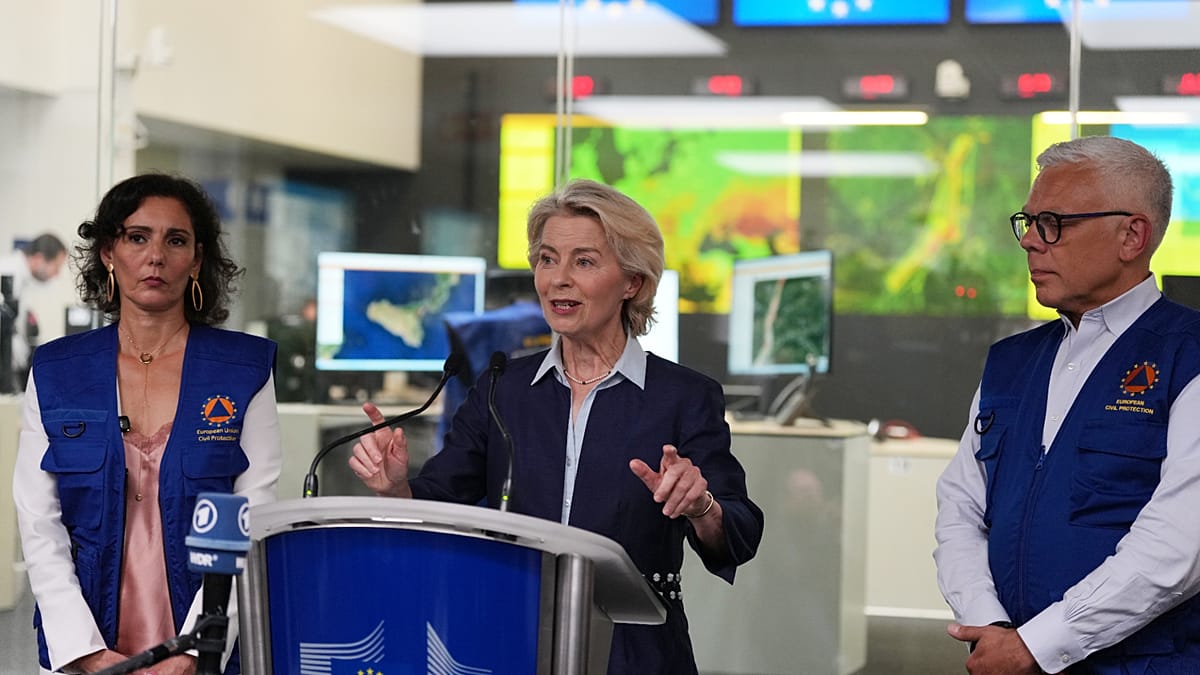
Von der Leyen warns of worsening disaster risks, touts preparedness
The European Commission wants to shift the focus from responding to disasters to preventing them, strengthening preparedness and improving anticipation. But fi…
Metsola: Europeans want us to stand up for values
“People want us to stand up for a Europe of values,” the European Parliament President Roberta Metsola said in her introductory remarks before the State of the Union Speech.
In her view, Europe should be a place where “you can afford to pay your bills, scale your start-up, live in freedom, love who you wish to love, and be who you wish to be”.
Metsola also underlined the importance of press freedom, justice and the rule of law as “the hallmarks of our way.”
Words are good with China, but deeds are better, Ursula von der Leyen says
European Commission President Ursula von der Leyen called on China to speed up the ongoing discussions to rebalance the trade relationship between Brussels and Beijing.
"Let me be clear: we will use all tools at our disposal to rebalance our relationship. Words are good. But deeds are better," von der Leyen said.
She recalled that the trade deficit with China is now €1 billion a day. “It has reached a tipping point,” she added.
“Some say the second China shock is looming. But it's already here. It shows in our communities and factories across our Union. It leads to de-industrialisation in the industrial heartlands of Europe. This is unsustainable.”
The President has threatened several times in the past to adopt unilateral trade defence measures if dialogue with China did not reach concrete results.
The Europeans have set themselves an October deadline to make progress in the talks.
Von der Leyen says Europe must fight back against 'ultra-nationalists, anti-Europeans and Russian interference'
Ursula von der Leyen has urged Europeans to "fight back" against the forces that seek to "weaponise" everyday concerns, such as wars, global competition and disruptive technology, to "drive a wedge between us".
"A battle of narratives is seeking to weaken confidence in Europe, to paralyse our democracies," she says. "We see this in the rise of the extreme, the decline of nuance, even in the way that we relate to each other."
"So our choice is clear," she tells MEPs. "Do we want a strong and independent Europe that stands up for its values in this world? Or do we want to rally around our European idea that together we can decide our own destiny? Or do we let our democracies be undermined by the proxies and puppets of authoritarians?"
Von der Leyen name-checks ultra-nationalists, anti-Europeans, Russian interference and disinformation as those seeking to divide the bloc.
"The names may be different, but their goal is the same. They despise our values, and they want to shatter our European unity. So let's not only fight back against that, but let's fight together for our European idea."
Her speech comes after the far-right AfD party swept the election in Saxony-Anhalt, in her native Germany.
VDL maintains energy path centered on domestic clean power and electrification
Von der Leyen reiterated previous pledges to double the electrification target to 46% by 2040 as one of the ways to cut its fossil-fuel import bill by €260 billion a year. But to reach that goal, the bloc needs to massively invest in grids and energy storage.
"We need to double down on our affordable and homegrown clean energy. Be it renewables and nuclear. Or biomethane and others. Technologically neutral. But they must give us independence," von der Leyen said.
The Commission chief can point to diversification, renewables and reduced dependence on Russian fossil fuels. But for consumers and energy-intensive companies, the more immediate question is whether Europe's new energy system will actually be cheaper.
Von der Leyen pushes to move forward implementation of Draghi and Letta reports to make Europe more competitive
With the EU single market and "world-class industry and services," the bloc has the foundations to compete and scale alongside major global powers such as China and the United States.
But the EU is still too fragmented, European Commission President Ursula von der Leyen said during her speech at the European Parliament on Wednesday.
"This is why when we took office, we put in place a bold plan. To build an economy where innovation and energy flows across borders. Where companies compete and grow across Europe, and savings finance our future. This is the logic of the Draghi and Letta reports. And together we are delivering," the president said, referring to the former Italian Prime Ministers Enrico Letta and Mario Draghi, respectively on the single market and competitiveness.
"We now have the political agreement on the One Europe, One Market Roadmap. And together, by the end of next year, we can and must complete this historic overhaul of the Single Market," the president added.
'Clear fiscal choices will have to be made to ensure fiscal sustainability,' von der Leyen says
Europe needs to be ready to make 'clear fiscal choices' for its citizens, European Commission President Ursula von der Leyen said during her State of the Union speech on Wednesday.
"Our economy has withstood the impact of the Middle East wars better than expected. And unemployment is at near-record lows. But the pressures from higher energy prices and borrowing costs are biting for people and for business," the president said.
"Clear fiscal choices will have to be made to ensure fiscal sustainability, while protecting investment. So, kickstarting Europe's economy is our number one priority," von der Leyen added.
Europe has increased defence spending by 80% in five years
Von der Leyen just trumpeted the fact that in the face of an increasingly hostile security situation, Europe is stepping up to the plate, and has increased its defence spending by 80% over half a decade.
"This is a Europe that stands up for each other," she said, adding that Ukraine is also supported in this fight.
"Or when when we stood up for Greenland when threatened," she said.
"Or when drones, hybrid attacks or disinformation target our democracies."
'The best of times, the worst of times': Von der Leyen begins speech by quoting Dickens
Ursula von der Leyen begins her speech with the iconic opening line of Charles Dickens's A Tale of Two Cities: "It was the best of times, it was the worst of times."
"It is also a fair description of the world we live in today. The speed of change is incredible. The challenges exceptional," she said. "So if I look at Europe today, my take is this. The state of our Union is the strongest it has ever been. The state of our Union can also feel as precarious as it has ever been."
"These two statements may seem incompatible," she goes on. "But they are both true. And they reflect these exceptional times. This complex age of great possibilities and great perils, which all countries are seeking to navigate."
Standing ovation for Mark Carney
Canadian Prime Minister Mark Carney has received a standing ovation inside the European Parliament after being introduced by Roberta Metsola as the guest of honour.
"They haven't even heard your speech yet," Metsola jokes.
Carney will address the Parliament tomorrow morning.
Von der Leyen, Metsola and Carney enter the chamber
Ursula von der Leyen, Roberta Metsola and Mark Carney, the guest of honour, have entered the plenary chamber together.
They are received with applause.
Lagodinsky tells Euronews EU has no choice but to use next budget to fund priorities
The EU does not have other options but using the upcoming EU budget to finance its priorities, member of the European Parliament Sergey Lagodinsky from the Greens told Euronews at its flagship program Europe Today on Wednesday.
"I think we will not have any other option but looking at a new MFF," the MEP said referring to the Multiannual Financial Framework for the period 2028-2034.
The European Union is negotiating its budget and is expected to find a deal by the end of the year. Net payers countries are pushing for substantial cuts and prioritisation of security and defence.
MEPs are entering the hemicycle
We can see MEPs slowly making their way into the plenary chamber in Strasbourg.
The session will begin with European Parliament President Roberta Metsola.
Charles Michel: Von der Leyen was 'naive' in following the US blindly
Former European Council President Charles Michel has told Euronews that Commission President Ursula von der Leyen followed the United States blindly, describing her approach as naive.
Donald Trump had earlier threatened the European Union with additional tariffs, before the two sides struck a trade deal. Michel, who served as President of the European Council from 2019 to 2024, spoke to Euronews in Brussels ahead of von der Leyen's address.
"She started her mandate by blindly following the United States, with a lot of consequences. There was a kind of naivety," Michel said, adding that many leaders had called for greater sovereignty at the time.
"A lot of time was lost," he said.
MEP Bernd Lange: 'We will use our weapons' if no China trade deal by October
German MEP Bernd Lange has told Euronews that the European Commission should use its "weapons" if a trade agreement with Beijing is not reached by the October deadline.
The German social democrat, who leads trade negotiations on behalf of the European Parliament, told Euronews' morning show Europe Today that he remains hopeful of a deal.
"My estimate is 51% in favour of getting a result. But it's not a given — let's see. So we have to be clear: if there is no agreement, then we use our weapons," Lange said.
Metsola says Parliament will 'demand answers' from von der Leyen
Roberta Metsola, the European Parliament president, briefly spoke to the press before the start of the State of the Union speech, which she called a "big day" for the European Union.
Lawmakers will "ask questions and demand answers" from von der Leyen, she said, with a focus on four priorities: competitiveness, security, climate action and social protection. There are still "too many gaps" between member states and between urban and rural areas, she noted.
Metsola said she was "especially proud" to welcome Canadian Prime Minister Mark Carney to the Parliament. "From this house, we're projecting Europe as a geopolitical actor," she said. "We want to embed and deepen our relations with friends across the world."
Austrian MEP Mandl calls for EU deregulation and investments
Austrian MEP Lukas Mandl has called for deregulation and increased investment ahead of European Commission President Ursula von der Leyen's State of the Union address.
Speaking to Euronews' Maria Tadeo on Europe Today, the centre-right politician, a member of the European People's Party, said that simplifying rules to encourage investment was not sufficient.
"Simplification is not enough, gratification is not enough. The economy needs deregulation," Mandl said, adding that von der Leyen must address issues such as the economy, demographic change and integration.
On von der Leyen's leadership, Mandl said: "We have her in these troubled times, and in troubled times it's extremely important to rally around the leader, and also to support the leader."
Did von der Leyen make good on the promises she made last year?
Before the speech begins, let's take a moment to review the promises von der Leyen made last year and the results she delivered (or not).
Our team put her work to the test.
State of the Union: Did von der Leyen make good on her promises?
Did Ursula von der Leyen deliver on all the promises she made in last year's State of the Union speech? Euronews puts her work to the test. #EuropeNews
State of the Union: Here's what to expect
Good morning and welcome to the Euronews live blog!
Here's a rundown of what to expect:
- Shortly after 9 am, Ursula von der Leyen will deliver her State of the Union speech in Strasbourg.
- Following her speech, the leaders of each political group will take the floor in order of representation.
- After that, von der Leyen will reply to the group leaders.
- Thomas Byrne, Ireland's minister for European affairs, will take the floor on behalf of the EU Council's rotating presidency.
- Then, other lawmakers from different parties will intervene.
- Von der Leyen will deliver a final reply.
- Group leaders will reply in reverse order of representation.
The session is expected to finish at around 12.30 pm.