




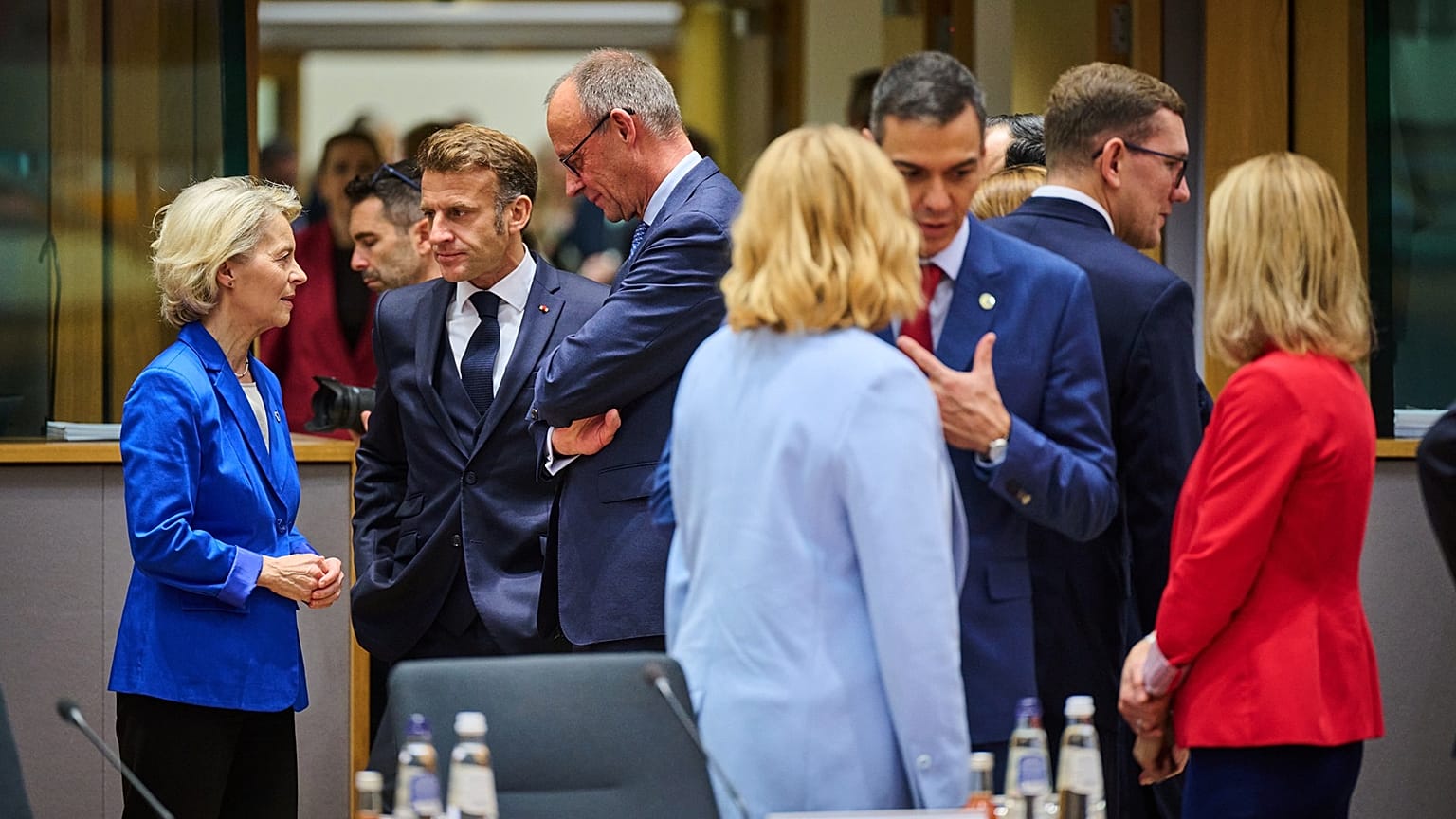












Die 27 Staats- und Regierungschefs der Europäischen Union entscheiden in Brüssel, woher mindestens 90 Milliarden Euro kommen sollen, um die Ukraine in den nächsten zwei Jahren in Russlands Angriffskrieg und beim Wiederaufbau zu unterstützen.
Die 27 Staats- und Regierungschefs der Europäischen Union kommen in Brüssel zusammen, um eine seit Monaten erwartete Entscheidung zu treffen: Wie sollen mindestens 90 Milliarden Euro aufgebracht werden, um den finanziellen Bedarf der Ukraine für 2026 und 2027 zu decken?
 WERBUNG
WERBUNG
WERBUNG
Da die USA auf eine schnelle Einigung zwischen der Ukraine und Russland drängen, sehen Diplomaten und Beamte den Gipfel an diesem 18. Dezember als einen wichtigen Moment für die Europäer, um zu beweisen, dass sie "immer noch etwas zu sagen haben".
"Hier geht es nicht nur um Zahlen", sagte die Präsidentin der Europäischen Kommission, Ursula von der Leyen, im Vorfeld des Gipfels. "Es geht auch darum, die Fähigkeit der Ukraine zu stärken, einen wirklichen Frieden zu sichern - einen gerechten, einen dauerhaften, einen, der die Ukraine und damit auch Europa schützt."
Indes sickerte durch, das Bundeskanzler Friedrich Merz (CDU) anbietet, russische Vermögenswerte, die in Deutschland lagern, für die Ukraine freizugeben.
Es gibt grundsätzlich zwei Hauptoptionen, um die mindestens 90 Milliarden Euro aufzubringen. Die erste ist der Vorschlag, die stillgelegten Guthaben der russischen Zentralbank in ein zinsloses Reparationsdarlehen an die Ukraine umzuwandeln, das das Land erst dann zurückzahlen müsste, wenn Moskau den durch seinen Krieg verursachten Schaden wiedergutgemacht hat - was äußerst unwahrscheinlich ist.
Die zweite Möglichkeit wäre eine gemeinsame Kreditaufnahme auf den Finanzmärkten, wie die Kommission im Namen aller Mitgliedstaaten während der COVID-19-Pandemie vorgegangen war.
Beide Optionen sind mit erheblichen Vor- und Nachteilen verbunden, die den Staats- und Regierungschefs Kopfzerbrechen bereiten. Es gibt jedoch einen entscheidenden Unterschied: Die gemeinsame Verschuldung müsste einstimmig beschlossen werden, um die EU-Haushaltsregeln zu ändern. Dies ist ein nahezu unmögliches Szenario aufgrund der kompromisslosen Opposition Ungarns. Das Reparationsdarlehen dagegen könnte mit einer qualifizierten Mehrheit genehmigt werden.
Diese Arithmetik hat Belgien ins Rampenlicht gerückt. Im Land lagern russische Vermögenswerte in Höhe von 185 Milliarden Euro und Belgien befürchtet u.a., dass es im Falle eines Reparationskredits Opfer von Vergeltungsmaßnahmen Moskaus werden könnte. Der belgische Premierminister Bart De Wever hat den Vorschlag als "grundlegend falsch" und mit "vielfältigen Gefahren" behaftet kritisiert.
Auf dem Gipfeltreffen am Donnerstag werden die Staats- und Regierungschefs daher versuchen, die zahlreichen Bedenken von De Wever zu zerstreuen und die Beteiligung Belgiens an dem Plan sicherzustellen. In den letzten Tagen haben zudem Italien, Bulgarien, Malta und die Tschechische Republik Vorbehalte gegen das Reparationsdarlehen geäußert, und auch Euroclear, die Verwahrstelle für die 185 Milliarden Euro, hat sich kritisch geäußert.
António Costa, der Präsident des Europäischen Rates, versprach, dass Belgien nicht überstimmt werden würde. "Dies ist kein Streit zwischen Europa und Belgien", sagte er.
Wenn es den Staats- und Regierungschefs gelingt, Bart De Wever zu überzeugen, kann das Reparationsdarlehen in die Tat umgesetzt werden. Gelingt dies nicht, werden sie unter dem Eindruck des ungarischen Vetos über gemeinsame Schulden diskutieren. Erweisen sich die beiden Optionen als nicht realisierbar, muss die Kommission schnell eine Zwischenlösung finden, um die Unterstützung für die Ukraine ohne Unterbrechung fortzusetzen.
"Das Treffen wird so lange dauern, wie es nötig ist", sagte ein EU-Beamter und deutete an, dass sich die Debatte über den Freitag und sogar darüber hinaus erstrecken könnte.
Kyjiw braucht im April eine neue Finanzspritze. Nach dem letzten ergebnislosen Gipfel kann sich die EU ein weiteres Debakel nicht leisten. Da Washington und Moskau genau auf Brüssel schauen, heißt es in Brüssel, dass ein Scheitern keine Option ist.
Folgen Sie unserem Live-Blog für aktuelle Informationen.

 ${title}
Live beendet
See you next time!
That's a wrap from us (after 21 hours of live reporting), but don't fret, here's your final wrap of the summit:
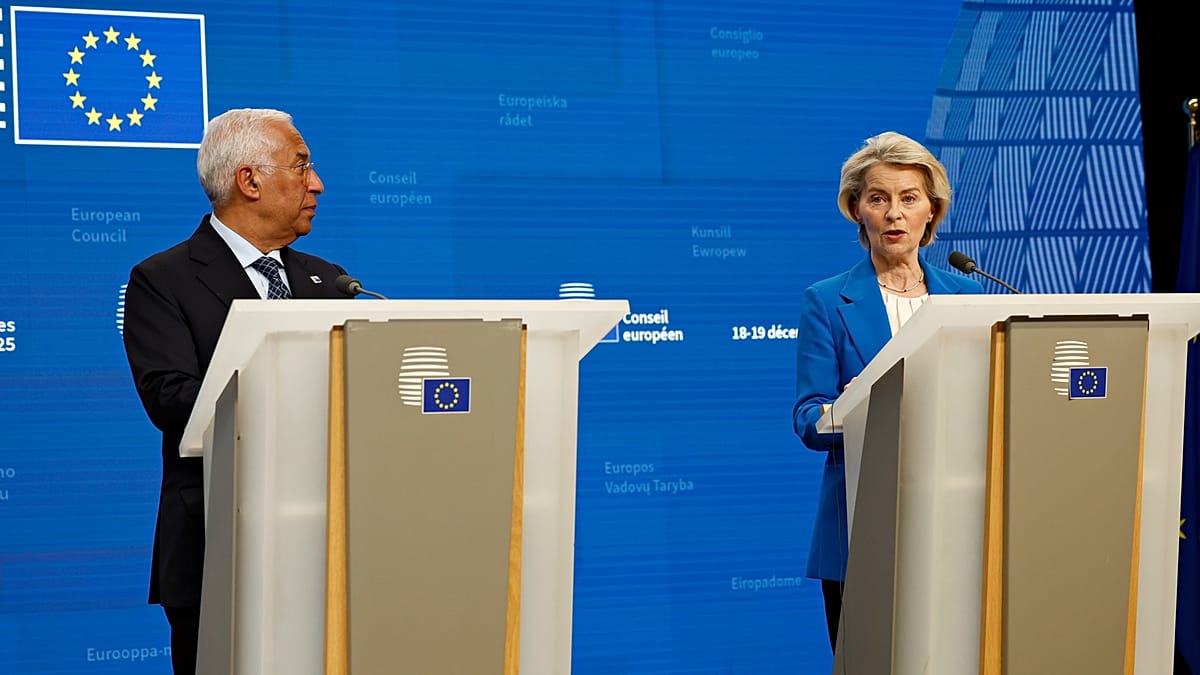
EU to issue €90 billion in joint debt for Kyiv but no reparation loan
EU leaders fail to strike a deal on an unprecedented reparations loan for Ukraine, turning to joint debt instead to finance a €90 billion loan. Hungary, the Cz…
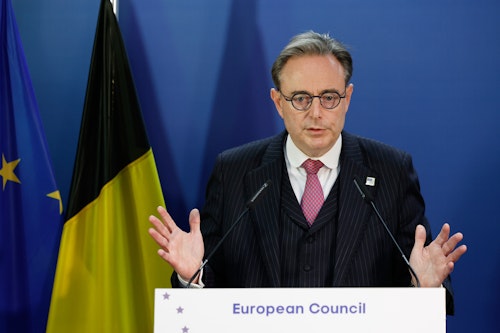
'Europe has won,' Bart De Wever says after reparations loan falls apart
It's fair to say that Belgian Prime Minister Bart De Wever has reasons to celebrate tonight. The reparations loan, the proposal he opposed from the start, has fallen apart in favour of joint debt, which he preferred.
"Ukraine has won. It received the urgent, predictable, and reliable financing it needs for the next two years, based on an EU borrowing on the capital markets backed by the EU budget headroom. This is not a fragile construct. This is a stable, legally robust, and financially credible European solution. These are chartered waters; we are safe," he said at the end of the meeting.
"The immobilised assets will be kept immobilised and will ultimately be used to repair the damage Russia has caused with its unprovoked and unjustified war against Ukraine. Nobody in the European family wants to see that money return to Moscow," he added.
"Europe has won, and financial stability has certainly won. We avoided chaos, we avoided division. Europe stays united. A unity today means that Europe remains relevant at the geopolitical table."
In a clear dig at Germany, a vocal proponent of the reparations loan, De Wever said the decision by EU leaders proves that "the voice of small- and medium-sized member states also counts". By rejecting the proposal, the bloc avoided "stepping into a precedent that risked undermining legal certainty worldwide".
Associated Press.
Sánchez: 'Already too much patience on the EU-Mercosur deal'
Spanish Prime Minister Pedro Sánchez said that the trade deal with Mercosur countries is good for Europe, especially given the "commercial war launched by the United States" against the EU.
"There has already been too much patience on the part of all the stakeholders [...] I asked the member states that had last-minute doubts to think about Europe and to commit to an open Europe, given the opportunity being offered, especially to small and medium-sized enterprises, through this kind of trade agreements," Sánchez said.
The signature of the deal, initially foreseen for 20 December, was postponed as the qualified majority of the EU states needed to validate it was not reached.
Sánchez also expressed satisfaction with the agreement to grant Ukraine a loan of €90 billion to finance its needs for 2026 and 2027.
He also touched upon rules for the automotive sector's emissions, which the Commission recently proposed to revise.
“We believe that the Commission’s proposal to amend the phase-out of combustion-engine vehicles beyond the year 2035 is a mistake that sends mixed signals to the automotive industry and consumers. Ultimately, it will delay investments and benefit other countries that are direct competitors in the manufacturing of electric vehicles," Sánchez said.
Mercosur: ‘We will fight,’ Macron says
French President Emmanuel Macron said he will “fight” to secure guarantees for farmers before backing the Mercosur trade agreement concluded by the European Commission in 2024.
“I reiterated that the agreement was unacceptable in its current form,” Macron said after an EU summit, adding: “It was therefore inconceivable to force a decision by the Council to allow the signature of the agreement.”
After hours of tense talks among EU leaders, Commission President Ursula von der Leyen on Thursday pushed the signing ceremony to January. The agreement was due to be signed on Saturday in Latin America.
The deal with Argentina, Brazil, Paraguay and Uruguay aims to create a transatlantic free-trade zone but EU farmers fear it would expose them to unfair competition on the bloc’s market.
Macron reiterated his demand for robust safeguards to protect farmers and said that, together with Italy, Poland and Ireland, he had asked the Commission for assurances that the future Common Agricultural Policy budget would be maintained and not cut by 20% as planned.
“We will fight,” Macron told reporters, adding that he did not yet know France’s position for a January vote.
Paris, a long-standing opponent of the deal, secured key backing from Italy on Thursday. But Prime Minister Giorgia Meloni said after a phone call with Brazilian President Luiz Inácio Lula da Silva that she supports the agreement but wants guarantees for Italian farmers.
Meloni satisfied with financing for Ukraine and postponing the signature of the EU-Mercosur deal
Italian Prime Minister Giorgia Meloni expressed satisfaction after the conclusion of the European Council, both on the solution found to finance Ukraine and on the postponement of the signature of the EU-Mercosur trade deal.
"I am glad that common sense has prevailed and that we have been able to guarantee the resources needed [by Ukraine], but with a solution built on a solid legal and financial basis," Meloni said.
The Italian premier added that a reparations loan based on Russian immobilized assets is not off the table in the future. "The most important decision on the matter was already taken a few days ago, when we froze the assets, effectively ensuring that they are not returned [to Russia]”, she said.
“Today's conclusions state that the EU, in line with the existing rules, the rule of law, and so on, reserves the right to consider the use of these assets, especially to repay the loan [to Ukraine]. Clearly, this is a work in progress."
Meloni was also satisfied with the outcome of the discussion on the trade deal with South American countries, which will not be signed off on 20 December as initially foreseen by the European Commission.
"Postponing the summit with Mercosur [countries] gives us additional weeks to try to provide the answers requested by our farmers, the safeguards that are necessary for our products, and thus enable us to approve the EU-Mercosur agreement when we have all the guarantees required by a sector that could otherwise be affected," she said.
Italy's position was pivotal on the matter, as it could determine whether a qualified majority of EU member states required to sign off on the deal can be reached.
Opt-out for Hungary, Czech Republic, Slovakia on Ukraine loan 'doesn't move the needle financially', Macron says
French President Emmanuel Macron told reporters that the opt-out Hungary, Slovakia and the Czech Republic have obtained when it comes to the loan for Ukraine "doesn't move the needle financially" given the sizes of the three countries' economies.
"What would have been very worrying, intellectually speaking, is if one country had wanted to block the decision. And I think it was very important that you had unanimity on the decisions. So I see this as a sign of trust and solidarity," he said at his end-of-summit press conference.
The French leader also said the opt-out has previously been used on other occasions, notably during the financial crises.
Macron also said there is "no proper and formal timeline" for leaders to agree on the reparations loan "because the first option is secure".
"We delivered what we committed to do to Ukraine," he went on. "The absence of decision would have been a disaster. Happily, we took a decision. A clear decision, a clear commitment, with concrete results. So this summit is a very good one for Ukraine."
'We have made it,' von der Leyen says despite failure to clinch deal on tapping Russian immobilised assets
"We made it. We have secured an agreement that can deliver on the financial needs of Ukraine for the next two years," European Commission President Ursula von der Leyen has told reporters at the European Council in Brussels.
She hailed the breakthrough as a major win, despite her being a major proponent of the alternative plan of tapping Russian immobilised assets to issue a reparations loan to Ukraine.
She also declined to close the door on the leveraging of the assets.
"The immobilised Russian assets will remain immobilised and the Union reserves its right to make use of the cash balances to finance the loan," she said, referring to the €90 billion cash pot that will be raised using joint EU debt.
Orbán: 'It is a bad decision, which brings Europe closer to the war'
Hungary's Prime Minister Viktor Orbán labelled as "a bad decision, which brings Europe closer to the war" the choice of the European Council to grant Ukraine a loan of €90 billion, financed through a joint borrowing by EU countries.
"It looks like a loan, but of course, the Ukrainians will never be able to pay it back. So it is basically losing money. And those who are behind that loan will take the responsibility and the financial consequences of that," Orbán said.
Hungary, Slovakia, and the Czech Republic will not participate in the loan after having obtained an opt-out in exchange for lifting their vetoes on the proposal. "The loan requested a unanimous decision, and finally, we have given up the right to veto, and we got in exchange the opt-out," Orban said.
Despite considering the final outcome as bad, Orbán said that a reparations loan using Russian assets immobilised in Europe would have been even worse.
"A reparations loan would mean a war immediately. Think about it: there are two parties warring against each other. You are a third one who goes there, taking away a huge amount of money from one and giving it to its enemy. What does it mean? It's war," Orbán said.
Merz spins summit as 'great success' despite failure to agree on reparations loan
German Chancellor Friedrich Merz told reporters that "Europe has demonstrated its sovereignty" by agreeing to issue common debt to finance Ukraine's needs and to finally strike the long-awaited trade deal with the Mercosur bloc.
This is despite the fact that the interest-free loan for Ukraine backed by headroom in the EU budget was seen as the second-best option and that the Mercosur deal is delayed by at least "two weeks". European Commission chief Ursula von der Leyen was supposed to fly to Brazil this weekend for the signature ceremony.
Still, Merz told reporters that leaders "were really put to the test today" and had been "confronted with the question of whether we had really understood the challenges in geopolitics" and that "the answer is clearly yes".
The German Chancellor, who had been one of the most vocal proponents of using the immobilised Russian assets to create a reparations loan, said this option "would have required important securitisation mechanisms".
"When it comes to Russian assets, we just changed the timeline a bit," he also said, adding: "Russian assets will be used as securitisation for the loan."
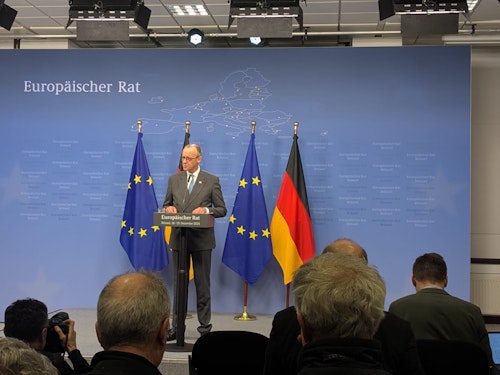
Ukraine to receive 'interest-free loan of €90 billion' as leaders fail to agree on reparations loan
The meeting is over and German Chancellor Friedrich Merz has taken to X to announce that Ukraine will "receive an interest-free loan of €90 billion".
"This sends a clear signal from Europe to Putin: This war will not be worth it. We will keep Russian assets frozen until Russia has compensated Ukraine," he added.
The financial package for Ukraine is in place: Ukraine will receive an interest-free loan of 90 billion Euros as I suggested. This sends a clear signal from Europe to Putin: This war will not be worth it. We will keep Russian assets frozen until Russia has compensated Ukraine.
— Bundeskanzler Friedrich Merz (@bundeskanzler) December 19, 2025
EU secures €90 billion for Ukraine, António Costa says
We have a deal.
— António Costa (@eucopresident) December 19, 2025
Decision to provide 90 billion euros of support to Ukraine for 2026-27 approved.
We committed, we delivered.
Hungary, Slovakia and the Czech Republic off the hook from joint debt, according to new conclusions
Euronews has obtained the latest draft of the conclusions, which confirm our scoop: the EU will set up a scheme of so-called "enhanced cooperation" to ensure that any use of the EU budget to raise joint debt "will not have an impact on the financial obligations of the Czech Republic, Hungary and Slovakia."
This appears to be the key concession to cement the necessary unanimity to use the EU budget as a guarantee for the common borrowing. It's an untested scenario meant to set a precedent.
It's still unclear how much money the EU will raise through the scheme of joint debt. The bloc is meant to pledge €90 billion to cover Ukraine's needs for 2026 and 2027.
Back in business! 💪🇭🇺🇨🇿🇸🇰 pic.twitter.com/3sMffH7XYC
— Orbán Viktor (@PM_ViktorOrban) December 18, 2025
Costa proposes to combine joint debt with reparations loan, as talks remain stuck
António Costa, the president of the European Council, has proposed raising common debt to meet Ukraine's most immediate financial needs for 2026 while technical and legal work on the reparations loan continues in the coming months, Euronews has learnt.
The mix-match solution was pitched after the revised compromise on the reparations loan, designed to satisfy Belgium's concerns, raised more questions than expected, suggesting a definitive solution on the unprecedented scheme would not be found anytime soon. Faced with a stalemate, Costa has brought up Plan B of joint debt backed by the EU budget to ensure Kyiv receives fresh assistance as soon as April and secures the approval of a new programme by the International Monetary Fund.
"There was a lengthy discussion on how to deliver on the commitment to cover Ukraine's financial needs for 2026-2027. Not only the reparations loan is being discussed, but also the possibility of using the headroom of the EU budget, as some leaders mentioned it specifically," an EU official said. "After lengthy discussions, it is clear that the reparations loans will require more work as leaders need more time to go through the details."
Costa's compromise is still being discussed by leaders.
Absolute silence as leaders remain sequestered
It's past 1 am, and we still don't have any information about a potential deal. Leaders have been sequestered in the main room, without phones, since around 9 pm, which means there's essentially no information coming out.
The press room is still packed with journalists, waiting for any signals that might give a hint of where things are going.
Hungary, Czechia and Slovakia pitch joint debt for Ukraine - without them
In an unusual turn of events, Orban, Babis and Fico are preparing a plan for joint debt for Ukraine, which would leave them out but leave the other 24 member states free to do it. They see this as a compromise between a reparations loan and EU joint debt. It would be common issuance but only for those willing to pay for Kyiv.
The member states willing to participate would do so under the provisions of the Enhanced Cooperation foreseen in the EU Treaties
That’s according to a diplomat familiar with the matter speaking to our EU editor Maria Tadeo. Crunch talks over how to fund Ukraine continue behind closed doors.
European Commission delays signing of Mercosur deal
Like we reported earlier, European Commission President Ursula von der Leyen will no longer travel to Latin America on Sunday after deciding to postpone the signing of the Mercosur trade agreement concluded in 2024.
The deal dominated tense talks among the 27 EU member states at Thursday’s summit.
Italy’s call to delay the vote scheduled for this week proved pivotal, halting plans for von der Leyen’s trip. Supporters of the agreement, led by Germany and Spain, had been pressing for a swift signature as shifting geo-economic dynamics push the EU to seek new export markets.
New compromise removes EU budget as guarantee after 2027
The latest compromise on the reparations loan makes one notable change to the proposal of the European Commission. It strikes out the possibility of using the next EU budget (2028-2034) to take over the national guarantees that member states would put forward to protect Belgium and Euroclear.
For the Commission, bringing the EU budget after 2027 would be the most solid and credible guarantee. But doing that would require unanimity when the new budget is approved.
It appears that Belgium fears this unanimity won't happen and prefers to keep the guarantees on a national level beyond 2027, at least for the time being. The guarantees will be "legally binding, unconditional, irrevocable and on-demand," the text says. Providing guarantees would be voluntary, but complying with them would be mandatory.
Are uncapped guarantees really on the table?
The latest compromise on the reparations loan contains many things, but one has already captured our attention. At one point, the text says "full and (uncapped) solidarity and risk-sharing" from the EU and member states towards countries and institutions that hold Russian Central Bank assets.
The word "uncapped" is fundamental here. Belgium arrived at the meeting demanding unlimited guarantees to cover itself and Euroclear, the depository with €185 billion in Russian assets, from any eventual scenario, including successful lawsuits in Russian-friendly jurisdictions.
However, diplomats from other countries have scoffed at the idea, believing it would be unfeasible, or maybe downright illegal, for their governments to sign up to guarantees without a financial limit.
Here's what's in the latest compromise of the reparations loan
Euronews has just seen the revised text of the conclusions addressing the reparations loan.
It runs for two pages and is split into bullet points to address the Belgian demands. It notes the assets of the Russian Central Bank will remain immbolised until Moscow ceases its war of aggression and compensates for the damages.
Then it lists a series of conditions to frame the proposal:
- Full respect for EU and international law to ensure there is no confiscation or expropriation of Russia's sovereign assets.
- Full respect for the contractual obligations between European financial institutions and the Russian Central Bank.
- Obligation to ensure that all EU institutions with Russian assets channel their funds into the reparations loans, "without exceptions" and at the same time. This provision will include banks in Germany, France, Cyprus and Sweden, besides Euroclear in Belgium.
- Coordinated withdrawal from all bilateral investment treaties that member states have with Russia.
- A liquidity mechanism based on "legally binding, unconditional, irrevocable and on-demand" guarantees to ensure the institutions can repay the Russian Central Bank at any given time.
- The possibility to issue a "secured debt instrument" that financial institutions will be able to exchange and rapidly obtain liquidity to honour their claims with the Russian Central Bank.
- Full solidarity to ensure "all costs" arising from the reparations loan are covered by member states collectively and that those affected can be properly reimbursed. (Notably, this part of the text leaves the word "uncapped" between brackets.)
- An effective "offsetting" mechanism to recoup losses incurred from Russia's retaliation, including expropriation and seizure of European assets.
- Guarantees shared by participating member states according to their economic weight. Payments to Ukraine will begin only after 75% of the guarantees are in place.
- The guarantees will not be counted against the debt level of member states.
- The reparations loan will be used to strengthen both Ukraine's and Europe's defence industries.
- The reparations loan will preserve the ongoing €45 billion loan by G7 allies, which was initially set up with the windfall profits from the Russian assets. G7 countries will be invited to set up schemes similar to the loan.
- Ukraine will be subject to anti-corruption milestones to obtain the assistance.
- The foreign and defence policy of each member state will be respected.
Debate on Ukraine finally begins
Now it's official: EU leaders have begun their debate on how to meet Ukraine's financial and military needs for 2026 and 2027. The bloc aims to raise €90 billion for the next two years.
Plan A, the reparations loan, is now on the table in a revised version to satisfy Belgium's concerns. But Plan B, the joint debt, is also part of the talks. So anything could happen.
All eyes are on Belgian Prime Minister Bart De Wever.
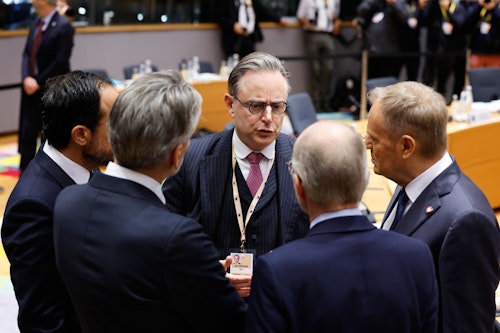
Leaders have received the revised text on reparations loan
It's happening: EU leaders are currently going through the revised text of the conclusions that outline a new framework for the reparations loan. The text is believed to be broken into bullet points that address the Belgian concerns, one by one.
While the reparations loan remains on the table, officials and diplomats suggest that a Plan B of joint debt will also be discussed in depth by leaders. However, it remains unclear how the EU could bypass the Hungarian veto to use the bloc's common budget to turn to the financial markets.
Vote on EU-Mercosur trade deal delayed to January, EU official confirms
There will be no vote on the EU's trade deal with the South American Mercosur bloc until the new year, an EU official has confirmed, after Italy backed France's call for a delay.
European Commission President Ursula von der Leyen had hoped to travel to Brazil on Saturday to seal the deal with the Mercosur leaders, including President Lula da Silva. Earlier, Lula and Giorgia Meloni held a phone call in which the Italian premier said she doesn't object to the deal but is seeking extra time to reassure Italian farmers.
Lula told reporters Meloni was facing "political constraints" but had vowed to find a solution in ten days to a month. It means the can is kicked down to January, much to the frustration to the deal's biggest proponents, including Germany and Spain, which had warned that a delay could kill the deal for good.
Leaders finish geo-economic debate and take a break
The 27 leaders have finished their discussion on geo-economics, which was shorter than expected, and are now taking a break. After that, they will discuss the main issue of the night, financing for Ukraine, over dinner.
Meloni-Lula call perceived as gamechanger for Mercosur dynamics
An EU diplomat suggested the mood surrounding Mercosur is much better compared to yesterday when it looked like the deal could fall through.
The fact that Meloni and Lula, the key players in the Mercosur, seemed to be aligned is a relief for the member states that want the deal. Keeping Lula engaged was seen as imperative after the Brazilian threatened he would walk out if a deal is not done this month.
Still, despite the new tone coming out of the summit, the diplomat suggested that the fact the call ended without a formal date - Brazil pointed to 10 days to a month - is making the supporters of Mercosur nervous.
When asked if the deal is now fully on track, the diplomat said the signs are pointing to the "right direction" but it's not set in stone. It's also not clear whether backers like Germany would agree to an accord in principle without a set date.
Technical talks continue on reparations loan to prepare new text for leaders
As leaders continue talks inside the room, there's a high level of activity going on in adjacent rooms.
The teams of the European Commission and the European Council are engaged in intense discussions with the team of Belgian Prime Minister Bart De Wever to design a new version of the conclusions endorsing the reparations loan for Ukraine. The text is said to be broken up into bullet points addressing each of the Belgian concerns.
The idea is to keep working on the text and then present it to the leaders after the dinner on geo-economics, which has not started. Then, the real debate will begin.
It is notable that the technical work is focusing exclusively on the reparations loan. Plan B, joint debt, has not yet been addressed, as it depends on unanimity.
Overall, there's a feeling of cautious optimism, even if there's still a long way to go.
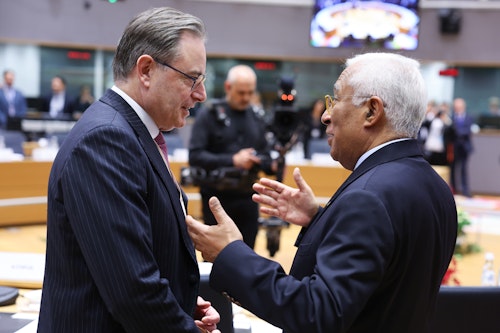
Leaders now discussing Middle East. The main issue of Ukraine financing will be kept until last
The 27 leaders are now holding a discussion on the Middle East.
Expect the discussion to be short: the issue has fallen down the priority list since a ceasefire was agreed for Gaza in October.
The Irish and Spanish leaders are likely to call on the bloc to extend its role in Gaza and the West Bank. Spain's Prime Minister Pedro Sánchez urged leaders upon his arrival to the Council earlier to be "coherent" in their response to Ukraine and Gaza, warning that the continent was facing increasing allegations of "double standards" from other countries.
Leaders will not move on to the crux of today's talks -- how they will raise tens of billions of euros to plug Ukraine's financial hole -- until the very end of the evening.
Meloni says Italy will back EU-Mercosur deal, but does not commit to a date
Italian Prime Minister Giorgia Meloni said her government is ready to sign off the EU-Mercosur deal but did not put a date on it as European leaders debate the controversial trade agreement.
European Commission chief Ursula von der Leyen was scheduled to attend a signature ceremony on 20 December in Brazil. Without member states' approval, the signature cannot go ahead.
In a statement following a phone call with Brazilian President Lula da Silva, Meloni struck a conciliatory tone saying she does not oppose the deal but that more guarantees are needed. Only after that the pact should be ratified.
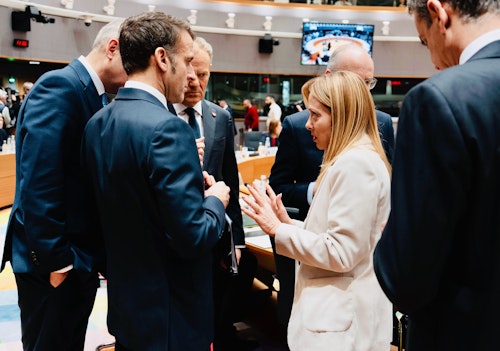
"The Italian government is ready to sign the agreement as soon as the necessary answers are provided to farmers. This would depend on the decisions of the European Commission and can be defined within a short timeframe," Meloni said.
In an address to the Italian parliament in Rome on Wednesday, Meloni poured cold water on the deal, calling it "premature". She argued that it would be "necessary to wait for the package of additional measures protecting the agricultural sector to be finalised, explained and discussed with our farmers".
After the call with Lula, she sounded more constructive.
Italy's position is pivotal because it could determine whether a qualified majority of EU member states required to sign off on the deal can be reached. Discussions continue in Brussels where leaders have not yet debated Mercosur formally.
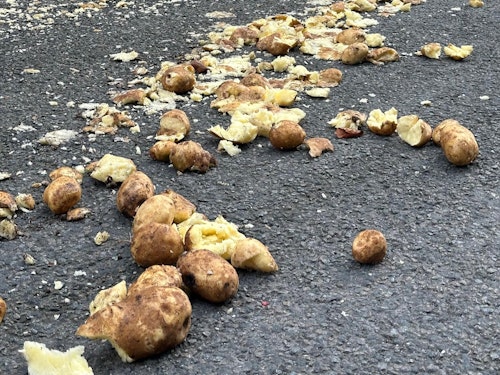
Brussels streets covered in potatoes as farmers head home
Fico hopes not to get 'defenestrated' over his opposition to the reparations loan
Slovakia's Prime Minister Robert Fico doesn't want to be thrown out of the window, literally.
"We are heading into the final stretch: deciding on a military loan for Ukraine," Fico wrote on social media as the summit progressed. "You know my opinion, so keep your fingers crossed that I don’t get defenestrated for holding a sovereign, different stance."
Fico has repeatedly said he opposes any fresh military assistance for Ukraine, even if he's more supportive when it comes to recovery aid and Kyiv's EU accession.
WHEN YOUR PLANE IS BROKEN, YOU HAVE TIME TO NEGOTIATE: EU SUMMIT IN FULL SWING
— Robert Fico 🇸🇰 (@RobertFicoSVK) December 18, 2025
Negotiations at the summit in Brussels are in full swing. After yesterday’s meeting with the countries of the Western Balkans, today we spent a very long time discussing such a “minor detail” as the… pic.twitter.com/DzgLWyOK54
EU leaders take a break in talks
Following their debate on the EU budget, the 27 leaders are taking a break in their talks. These breaks are generally used by heads of state and governments to hold bilateral talks and patch over their key differences. Expect the break to focus on the reparations loan for Ukraine and the Mercosur trade deal.
Police clears Place du Luxembourgh as farmers start departing Brussels
Following clashes, police officers cleared Place du Luxembourg, with some farmers seen leaving Brussels while honking their tractors' horns.
Beginning in the early hours of Thursday, demonstrators on tractors opposing the EU-Mercosur agreement had massed near the Europa building and the European Parliament.
La police évacue la place du Luxembourg à #Bruxelles après plusieurs heures de tensions devant le Parlement Européen.#Brussel #Brussels #Agriculteurs pic.twitter.com/8iYiOCfkoc
— Luc Auffret (@LucAuffret) December 18, 2025
Brazil's Lula says Italy's Meloni told him she is not against EU-Mercosur deal
Brazil's President Lula da Silva has said that Italian Prime Minister Giorgia Meloni told him in a phone call earlier today that she is not in principle against the EU-Mercosur free trade deal, despite her calling yesterday for a delay on an EU vote to seal the agreement.
Lula told reporters in Brasilia that Meloni said she faces "political constraints" due to the opposition of Italian farmers, according to comments reported in Brazilian media Globo.
"Even so, she stated that she is confident that she will be able to convince them to accept the treaty," Lula said. "Then she asked me if we were patient for a week, 10 days, a month at most, Italy would join (the deal's supporters)."
The Brazilian President had previously threatened to walk away from the deal, after Italy joined France in calling for its ratification to be delayed to next year.
His comments suggest a last-ditch effort from Meloni to assure South American counterparts that the deal can survive even if it isn't signed this week. European Commission President Ursula von der Leyen had hoped to travel to Brazil this Saturday to seal the deal, which has been a quarter of a century in the making.
Farmers' protest escalates at European Parliament
Tension rose at the European Parliament, as clashes intensified between farmers protesting the EU-Mercosur free-trade deal and police.
Euronews learnt from people who witnessed the action that the demonstration had been ongoing since early morning, with farmers camping in Place du Luxembourg and lighting small fires. Some farmers hurled potatoes, bananas and glass bottles at police officers, who responded by using water cannon to disperse the crowd.
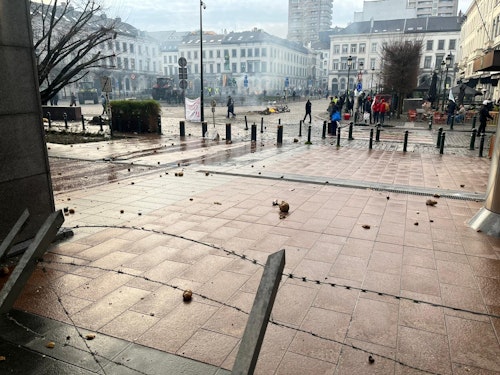
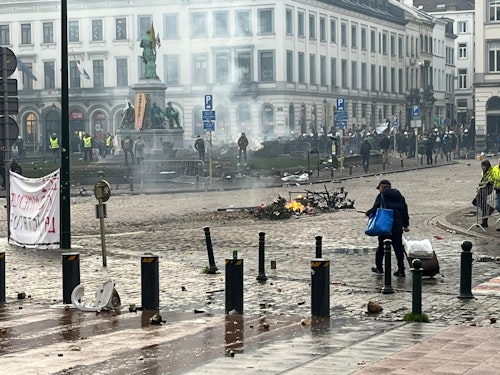
Videos circulating on social media show a tractor driving towards police officers, forcing them to retreat, as well as several demonstrators throwing stones, smoke grenades and fireworks in the direction of the European Parliament. One video shows an individual ramming the window of the building with a metal fence. Euronews could not independently verify these videos.
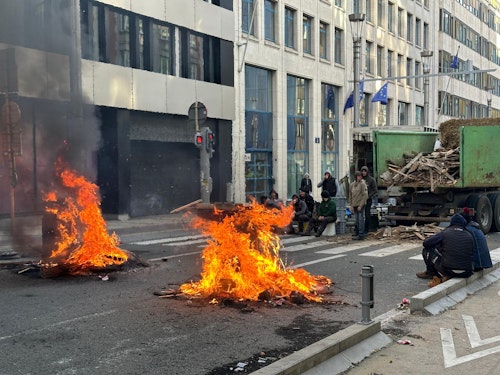
Farmers also blocked several other key roads and were positioned just outside of the security perimeter where EU leaders are attending a key EU summit. There too, farmers lit fires using firewood and other wooden objects, threw potatoes and launched fireworks into the air.
Leaders to work towards MFF deal before end of 2026
EU leaders have finished their discussion on the bloc's next seven-year budget, otherwise known as the multi-annual financial framework (MFF), that will run from 2028 to 2034.
The European Commission tabled a nearly €2 trillion proposal back in the summer that aimed to make the MFF more flexible and give the bloc's executive greater room for manoeuvre to deploy money according to the ever-changing circumstances inside and outside Europe.
An EU official said the leaders' discussion "showed a broadly shared openness to continue working on the basis of the new architecture, which modernises the EU budget and gives more flexibility", but that "at the same time, some important issues remain to be addressed in course of further work (agriculture, role of regions, cohesion, competitiveness fund, own resources…)".
"One of the main objectives of the discussion was to set the timetable for the negotiations. The debate demonstrated a shared understanding that it is important to have the new MFF in place right from the start of 2028 and to work towards an agreement by the end of 2026, if the necessary conditions are met," they added.
They are expected to return to the topic at their March 2026 summit.
"Time is of the essence to have a new budget up and running as of 2028," European Council President Antonio Costa said on X.
The EU has set itself an ambitious agenda - focused on security, competitiveness, and social cohesion.
— António Costa (@eucopresident) December 18, 2025
We need a long-term EU budget that gives us the means to achieve these ambitions.
Time is of the essence to have the new budget up and running as of 2028.
Orbán advisor to Euronews: Hungary can be constructive with conditions
Balázs Orbán, Prime Minister Orbán’s political director, told Euronews that Hungary is open to taking a constructive approach at the EU summit, but only under certain conditions, so as not to block plans to support Ukraine.
“We can only be constructive in solutions that do not involve tax increases, austerity, and additional borrowing for Hungary," Orbán said. "If there is such a solution, then of course we are constructive; if there is no such solution, then we are not interested, and then we cannot cooperate on this issue."
Orbán reiterated that Hungary does not support either of the two options on the table to meet Ukraine’s financial and military needs for 2026 and 2027.
“We made it clear at the beginning that we do not agree to the use of Russian assets, and that we do not have the mandate required by the constitution to contribute to joint borrowing, nor to borrowing that would be a financial burden for Hungary, either now or in the future," Orbán said, adding that "it is certain that the negotiations will last into the night," as "not everyone has laid out their cards."
"We play with open cards, after all," he said.
When Euronews asked whether Hungary would view it as a success if the EU failed to reach an agreement and Ukraine was left without funding next year, the political adviser sidestepped the question.
“For us, success would be peace, and if Europe were to recognise that what it is doing now is not leading anywhere, it is just a dead end. What they do now is the prolongation of suffering, and that is not in Europe's interest.”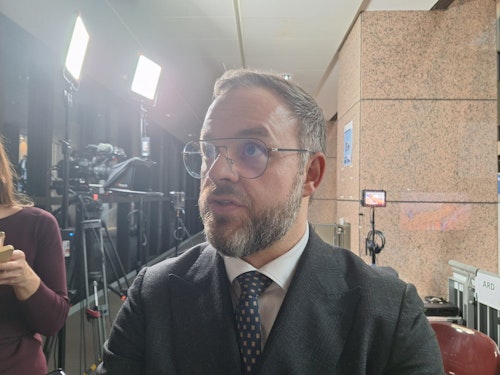
Farmers block roads in Brussels to protest EU-Mercosur free-trade deal
Police deployed tear gas and water cannon against thousands of farmers who converged in Brussels, blocking roads with tractors and hurling potatoes and eggs, as European leaders gather on the sidelines of the European Council summit, where they will debate a contentious trade pact with South America.
Demonstrators on tractors opposing the EU-Mercosur agreement massed near the Europa building, where leaders of the 27 EU member states met to discuss amending or postponing the trade deal, while a twin rally converged on Place Luxembourg, steps away from the European Parliament.
Read more on Euronews.
Farmers from across the EU have come together in Brussels to protest the Mercosur trade deal. pic.twitter.com/z7LmYmTV8G
— Irish Farmers Journal (@farmersjournal) December 18, 2025
Europe will look 'weak' if there's no deal on financing, warns Zelenskyy
Ukrainian President Volodymyr Zelenskyy has just shared a message on Telegram urging the European Union to show resolve and determination by agreeing on new financial assistance for his country. Otherwise, the bloc will look "weak" in the eyes of Moscow and Washington.
"I know that Russia is threatening different countries over this decision. But we shouldn't be scared of these threats – we should be scared that Europe will be weak," Zelenskyy wrote. "How can we trust future security guarantees if Europe can't even agree on a financial security guarantee for Ukraine in a situation that's clearly moral and fair?"
"If no decision is taken now, the Russians – and not only them – will feel that Europe can be defeated. Defeat is definitely not what Europeans need. They need Europe not to back down in the face of aggressors. No rewards for the aggressor – this is the basic principle of peace that must be reaffirmed," he added
"If we know, and if Putin knows, that we can remain steadfast, his motivation to prolong this war will be much weaker. And that is how pressure on the aggressor should work – pressure that brings peace. The aggressor must pay for what it has done."
Russia can't be allowed to exclude Europeans from security guarantees, says Zelenskyy
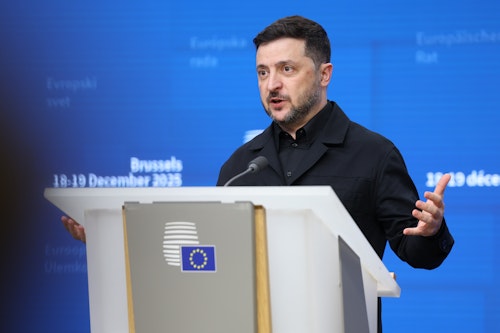
During his press conference on the margins of the European Council in Brussels, Volodymyr Zelenskyy also addressed the ongoing peace negotiations. Earlier this week, Europeans leaders outlined six security guarantees that they are ready to provide, with the support of the United States, as part of a peace treaty. One of these is a multinational force stationed in strategic points on Ukrainian soil, something that Moscow has repeatedly ruled out.
"We do not believe that Europe must substitute the United States of America," Zelenskyy told reporters. "No matter the signals that Russia transmits, we understand that they want to exclude the presence of the Europeans. This must not be allowed to happen."
"European presence will decrease the probability of Russia attacking again. The number of countries and the number of national flags in the Coalition of the Willing, in any format, no matter the number," he added. "It will bear high risks to start the aggression against Ukraine again. So for us, the European presence is important."
Another guarantee stemming from the Berlin talks on Monday is a "legally binding" commitment from Europe and the US to assist Ukraine in case of a future Russian attack. Zelenskyy said this pledge should receive approval from the US Congress to become a powerful and effective deterrent.
"When you don't have NATO, or you have a guarantee that it's NATO- like, somebody's saying maybe it's better. I don't know. My aim is not to evaluate it," he went on.
"I have one aim: to get an answer to the question: What will the United States of America do if Russia comes with aggression again? What will the security guarantees do? How will they work out? What will all partners do? With what pressure and what power will they stop Moscow? Specifically, I think we must get an answer to all that. But it must be fixed in certain documents."
Hungary, Slovakia, US currently against Ukraine's NATO membership, Rutte says
NATO Secretary-General Mark Rutte has just reiterated that the members of the military alliance agreed last year at a summit that Ukraine is on an "irreversible path" to join but that the bid must be approved unanimously by all allies.
"As we speak, a couple of allies are saying they will not give their consent and therefore will withhold unanimity to Ukraine entering NATO - countries like Hungary, the United States, Slovakia - and maybe a couple others," Rutte said during a joint press conference with Poland's Deputy Prime Minister and Minister for Defence Wladysław Kosiniak-Kamysz.
Asked about security guarantees, he said that they are currently being designed with three layers: strong Ukrainian armed forces, a so-called reassurance force from the Coalition of the Willing, and American guarantees.
"The American president said in August that he wants the US to be part of those security guarantees. And at the moment, discussions are ongoing what that exactly would mean and how then this collective package of security guarantees would look like," Rutte told reporters.
"It's extremely important because, indeed, after a peace deal, if not NATO, and NATO for practical reasons is not possible now, how do we prevent a further attack of the Russians? And Putin has to know that after a peace deal, that if he would try to attack Ukraine again, the reaction will be devastating. And this is exactly how we are designing these security guarantees," he said.
The Euroclear problem
The work on the reparations loan is more advanced than the public politicking suggests, but optics will be key. Belgium Prime Minister Bart De Wever is now seen as a unifying defender of his country, an ironic turn of events for a man who once suggested Belgium shouldn’t really exist.
Beyond the politics, there is a financial problem: even if de Wever manages to negotiate all the guarantees and back up against retaliation that demands, the reaction from financial markets remains an open question.
Earlier this week, credit ranting agency Fitch warned Euroclear, the depository holding the bulk of the immobilised Russian assets in Belgium, that it faces a downgrade to its AA score, citing its exposure to Russian retaliation, legal action and liquidity risks.
Fitch said it could review its assessment once the details around the reparation loan become clearer, but insisted insufficient guarantees would leave Euroclear exposed.
The question of exposure to companies and banks due to Russian retaliation isn’t exclusive to Belgium – Austria and Italy also pointed to similar concerns.
Mercosur: Meloni faces stark political choice
Italy's Giorgia Meloni holds the key to unlocking the Mercosur deal – but the prime minister won’t be swayed by technicalities around safeguards. The issue is political.
An official told Euronews that 10 days ago, Italy was in, but then something changed.
Meloni has revolutionised European politics by combining an institutional style with a side of populism, but the Mercosur deal forces her into a hard political choice.
Her domestic industry wants the deal passed, as it would be one of its main beneficiaries, but the deal comes with toxic baggage for farmers and her popular base. The deal also threatens to split Italy's governing coalition, dividing the pro-Mercosur Forza Italia from the Salvini-led Lega.
Meanwhile, one official suggested this is not the time to upset Brazil. “Lula is a proud man," they said of the country's president. "I wouldn’t test him further.”
Zelenskyy pleads for financial solution to avoid painful sacrifices
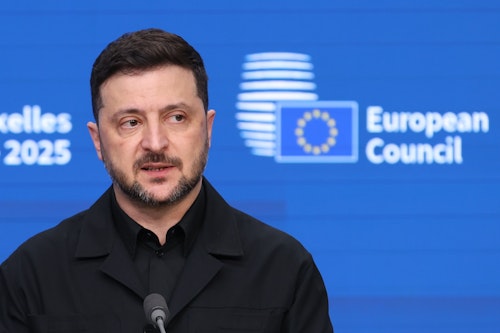
Ukrainian President Volodymyr Zelenskyy has just held a press conference after meeting with EU leaders. His message was stark: if Ukraine doesn't get fresh assistance in the spring, it will be forced into making painful sacrifices, including "significantly" reduced drone production and even territorial concessions.
"It is indeed a threat: 45 to 50 billion in deficit for sure," Zelenskyy told reporters. "The deficit can be even larger; we don’t know for sure how the events will unfold next year. We're doing everything to end the war."
"Such a deficit is not about the front line," he added. "It's overall about the capacity of Ukraine to fight. There are high risks for Ukraine. So I hope that the decision will be positive today."
Zelenskyy said the reparations loan was not only about financing but also about accountability to make sure that Russia pays for the damages it has caused.
Asked about this bilateral meeting with Belgian Prime Minister Bart De Wever, who's currently holding up the reparations loan, Zelenskyy said he understood the risks that Belgium is facing in the untested scheme but that Ukraine faces even "bigger risks".
"We need to solve this issue today or in the coming days so that Ukraine is not left without financial support," he said.
"If there is no question of finances, then there will be questions about the Donbas. These things are intertwined for our partners."
EU needs to do its homework to prepare for enlargement, official says
On the occasion of the EU-Western Balkans summit on Wednesday, EU leaders discussed the state of place of countries joining the bloc.
One EU official told Euronews that leaders "recognise that enlargement is a strategic investment in peace, security, and prosperity". They acknowledged that there is a momentum for enlargement, but also noted that the EU needs "to do its homework and prepare".
The spotlight for now remains on Ukraine and its EU accession process, which the official said is crucial for peace negotiations and security.
"Ukraine has made tremendous efforts under very challenging conditions. It is therefore crucial to find ways to advance Ukraine’s accession path," they explained.
On Moldova, leaders said that the "momentum needs to be preserved" as the country is making significant efforts in reforms to be able to join the EU.
And in the case of Serbia, EU leaders understand the need to encourage the country to turn away from Russia's influence.
The official said that while Serbia "has made concrete progress in pro-accession reforms this year", domestic challenges remain an obstacle.
Zelenskyy has held bilateral meeting with De Wever
Ukrainian President Volodymyr Zelenskyy has held a bilateral meeting with Belgian Prime Minister Bart De Wever. The Belgian leader is still resisting the reparations loan, based on the immobilised Russian assets, but says he is willing to approve the groundbreaking proposal if his three key conditions are met.
De Wever says he prefers to issue joint debt to meet Kyiv's military and financial needs.
What is Euroclear and what has it said about the reparations loan?
Today's political focus will be on Bart De Wever, the Belgian prime minister, who continues to resist the idea of channelling the immobilised Russian assets into a zero-interest reparations loan for Ukraine.
But where are these assets? The bulk of them, around €185 billion, is kept at Euroclear, a central securities depository based in downtown Brussels. This is the key reason why Belgium and De Wever have been thrust into the spotlight of the make-or-break debate.
Euroclear has been very vocal about its feelings on the reparations loan: it believes the unprecedented scheme could leave the company unprotected against an abrupt claim by Moscow and trigger an exodus of foreign investors from the eurozone, which could heavily jeopardise its business. Euroclear has a long-standing reputation in the financial world that it is keen to preserve.
"The proposal, as it stands, seems to have a great deal of legal innovation," a Euroclear spokesperson told Euronews earlier this month. "Such innovation raises a lot of questions. We have the impression that the construction is currently very fragile."
Read more about Euroclear's position.
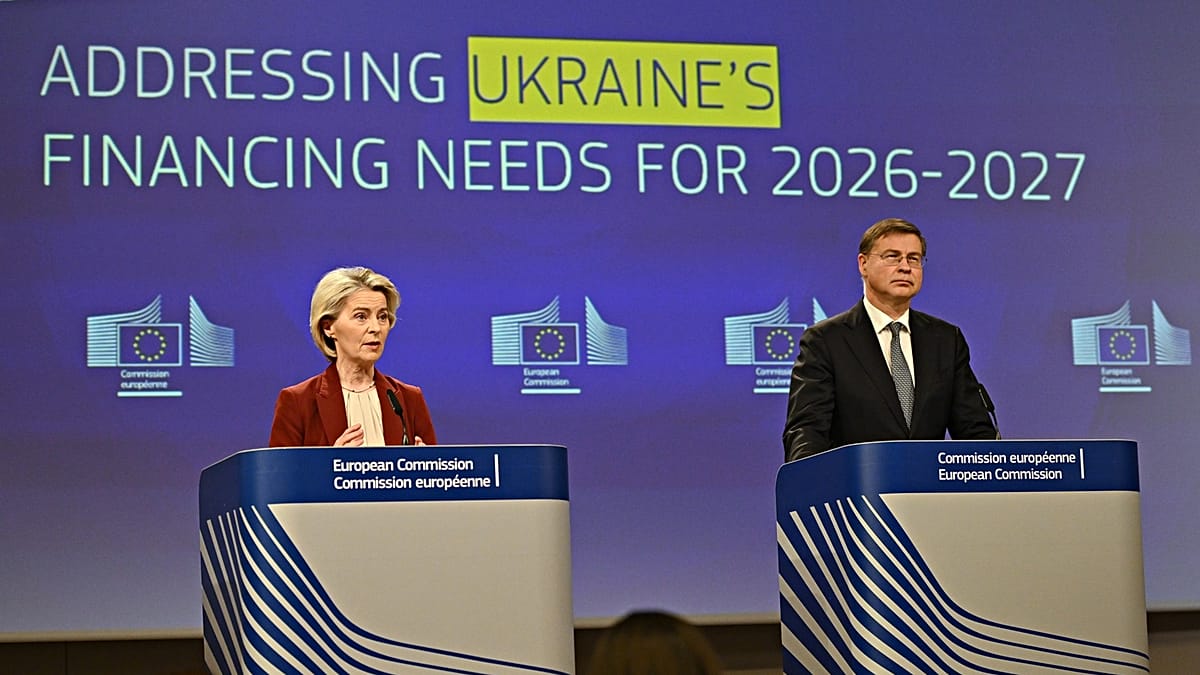
Reparations loan is ‘very fragile’ and risky, Euroclear warns
Euroclear, the custodian of the immobilised Russian assets, has criticised the reparations loan for Ukraine as fragile, unpredictable and risky. In Brussels, t…
Breaking down Belgium's three demands for the reparations loan
Belgium, the prime custodian of the immobilised Russian assets, is still resisting the reparations loan for Ukraine and prefers the option of joint debt. But that doesn't mean it is completely opposed to the proposal.
For the past few weeks, Belgian Prime Minister Bart De Wever has insisted on three conditions that must be met in return for his agreement. These are:
- Full mutualisation of risks: Belgium is demanding open-ended guarantees to protect itself against any eventual scenario, like a successful lawsuit that leads to multi-billion-euro damages. The proposal by the European Commission has capped the guarantees at €210 billion, the total value of Russian assets on EU soil. In recent days, ambassadors have increased the figure, but they have not yet agreed to provide unlimited guarantees, which might prove impossible for some capitals.
- Liquidity safeguards: Belgium is demanding that Euroclear, the Brussels-based institution that holds the bulk of the Russian assets, be able to honour its legal claim with the Russian Central Bank at all times and with absolute immediacy. The Commission is willing to lend money to member states that can't meet their pledged guarantees, therefore ensuring that Euroclear has liquidity. Additionally, the assets have been immobilised indefinitely to avoid an unexpected release.
- Burden sharing: Belgium wants every member state that holds Russian sovereign assets to participate in the reparations loan. These are: Germany, Sweden, Cyprus and France. In particular, France has about €18 billion of Russian Central Bank assets in private banks. The Commission says all sovereign assets on EU soil will be channelled into the reparations loan, but officials note the contractual obligations between the banks and Russia require further study. Belgium also wants other G7 partners (the UK, Canada and Japan) to mimic the reparations loan in their own jurisdictions.
De Wever is set to repeat those demands during today's summit. Will he obtain the necessary assurances from other leaders to agree?
Merz, De Wever and von der Leyen held 11th-hour talks last night
German Chancellor Friedrich Merz, Belgian Prime Minister Bart De Wever and European Commission President Ursula von der Leyen held another trilateral meeting yesterday evening in Brussels to discuss the reparations loan proposal, a person familiar with the talks told Euronews.
The three left a dinner with leaders from the Western Balkans early to discuss the plans in private.
This is the second time they have held such a trilateral meeting after Merz flew to Brussels on 5 December in a bid to allay Belgium's concerns over burden-sharing.
The German chancellor is among the most vocal proponents of the reparations loan to finance Ukraine's military and macro-financial needs for the coming two years.
Metsola: Joint declaration on ten legislative priorities to be signed by EU institutions
The European Commission, Parliament, and member states are set to sign a joint declaration on the ten legislative proposals to be prioritised for the time being, European Parliament President Roberta Metsola told journalists during a press conference on Thursday.
EU Parliament set to vote on reparations loan for Ukraine in January If deal reached, Metsola says
Reparations loan can be approved in the European Parliament in January if EU leaders strike a deal during today's summit, EU Parliament President Roberta Metsola told journalists on the margins of today's European Council.
"A vote can be set up during the next plenary session if leaders make a deal," Metsola said during her traditional press conference after addressing EU leaders at the Council.
EU leaders are racing against time to agree on a common plan to fund Ukraine's efforts against Russia for 2026 and 2027.
Two options are currently on the table: The first is to use frozen immobilized assets to create a zero-interest loan for Ukraine, which Kyiv would repay only if Russia later pays war reparations.
The second option would entail the EU jointly raising funds by borrowing from financial markets, following a model similar to the one used during the COVID-19 pandemic.
Zelenskyy pressed leaders to back reparations loan
Ukrainian President Volodymyr Zelenskyy made the case for EU leaders to back a reparations loan during his address, Euronews has learnt.
EU leaders are however not scheduled to discuss the issue of financing for Ukraine until later this afternoon.
The discussions have now moved to enlargement.
'Peace is not cheap,' Costa says as Zelenskyy joins talks
Peace is not cheap. It is priceless.
— António Costa (@eucopresident) December 18, 2025
Since the start of Russia’s aggression, the people of Ukraine have been paying the ultimate price for their freedom. Europe remains resolute in supporting them for as long as it takes.
Dear President @ZelenskyyUa, welcome back to the #EUCO. pic.twitter.com/mPA5x7pxgB
Vote on Mercosur should be delayed, Macron says
Macron also reporters that he is calling for a vote on the trade deal with the Mercosur bloc to be delayed, arguing that the agreement is not fully developed.
"It is about Europe's consistency, and it is about a Europe that protects its agriculture and its producers," he said. "We cannot accept sacrificing the consistency of our agriculture, our food, and the food security of our fellow citizens for agreements that have not yet been finalised. We have been very clear from the outset. We are asking for what is known as a safeguard clause."
Co-legislators on Wednesday struck a deal to implement even stronger safeguards hoping it would appease Paris, and increasingly Rome, but it still needs to be endorsed by member states.
"So it is not ready yet. But we are moving in the right direction," Macron said.
The French leader said he has had "a lot of talks" in recent days with Italian Prime Minister Giorgia Meloni, who now holds the power to either pass the deal or vote with a blocking minority to delay it.
"She also considers that things are not ready to be voted on today," Macron said.
Meloni, who addressed the Italian Senate on Wednesday, said of the deal that "as it stands, it is premature".
Supporters of the deal, including the Commission, Germany and Spain, argue that a delay risks killing the deal altogether. They claim the agreement would benefit Europe economically and politically as it seeks to diversify global ties after US President Donald Trump hammered the world with tariffs.
Brazilian President Lula da Silva threatened to pull out of the Mercosur agreement altogether if it is not approved before the end of the year. The trade bloc also includes Paraguay, Uruguay and Argentina, but Brazil is seen as the key player.
Zelenskyy now addressing EU leaders
Ukrainian President Volodymyr Zelenskyy, who is attending the summit in person but skipped the doorstep area, is now addressing his EU counterparts, an official has said.
This means the exchange with European Parliament President Roberta Metsola is over, and she should be answering journalists' questions shortly.
Austria’s Chancellor: ‘Illegal migration needs to stop’
Austria’s Chancellor Christian Stocker welcomed the latest “positive” EU developments on migration policy, noting that the bloc is “concerned” and has “recognised” that action is needed to tackle illegal migration.
"I have always had a clear position about the fact that illegal migration needs to be stopped,” Stocker told reporters ahead of the European Council summit.
EU leaders will take stock of the latest decision proposed by the European Commission that makes it easier to deport asylum seekers and irregular migrants in the EU.
Austria’s Chancellor shows solidarity with Belgium: 'We must take their concerns seriously'
Austrian Chancellor Christian Stocker stated that the European Commission’s proposal on Russia’s immobilised assets must have a clear legal basis to prevent any potential retaliation from Moscow.
Stocker expressed solidarity with Belgium’s delicate position, as Brussels holds most of the Russian immobilised assets at the Euroclear bank.
"We must take these (Belgium’s) concerns seriously,” Stocker told reporters on the sidelines of the European Council.
“Such a decision should not be made against Belgium. On the other hand, we will also have to solve the question of how we deal with frozen assets and our sanctioned assets one-sidedly," Stocker added.
Portugal’s Prime Minister backs 'several solutions' for Ukraine and calls on decent financing for agriculture
Portuguese Prime Minister Luís Montenegro told reporters today's Council summit will be "hard" and "intense", but that "it is possible to reach an understanding about the various subjects that are on the table”.
Portugal backs the use of immobilised Russian assets, but Montenegro said that "other solutions" or even "the combination of more than one solution" could also be used to keep Ukraine afloat.
Montenegro also flagged discussions on the EU’s multi-annual budget for 2028-2034 and said that financial mechanisms for cohesion are a must. He said that financing for agriculture and the outmost regions shouldn’t be overlooked because of the greater emphasis on security and defence.
On Mercosur, a trade deal that would affect 700 million consumers, Montenegro said it would be “unforgivable” not to strike a deal at today's EU summit.
A decision on Mercosur remains shrouded in uncertainty, or even indecision, Montenegro said.
'It’s regretful to see Georgia walking away from the EU,' says Lithuanian President
Lithuanian President Gitanas Nausėda said he was “a little upset” by recent developments in Georgia, which he believes signal a move away from the close relationship between Vilnius and Tbilisi.
“Although Georgia is far away from Lithuania, we have very close ties, emotional ties, historic, traditional ties, and it's regretful to see that Georgia is not coming closer,” Nausėda told reporters.
He regretted that Georgia is "distancing itself from the European Union” and from the bloc's rule of law.
"I think the situation will be very complicated, and it would be disappointing for Georgian people, who are expecting that the country will make bold progress towards the European Union,” Nausėda added.
Every member state must be 'heard and respected' on reparations loan, Macron says
French President Emmanuel Macron told reporters that a solution on financing Ukraine's needs for the coming two years "must" be found given that member states share the same objective of helping Kyiv sustain its war effort.
"We must find the right solution calmly and with mutual respect. The most important thing is that we all share the same objective: to help Ukraine finance its war effort and resist," he said upon arriving at the summit.
"We must not allow ourselves to be divided over technical details. Everyone must be respected and heard. We will therefore hold discussions with our Belgian colleague and with all our colleagues. I want this to be a collective, peaceful effort, but I am confident that we will find a solution."
Make-or-break EU summit begins
The EU summit has formally begun. All eyes are on Bart De Wever, the Belgian prime minister, who continues to resist the reparations loan for Ukraine, backed by a majority in the room.
"I won't give up," De Wever said on Thursday morning.
Stay tuned for updates throughout the day.
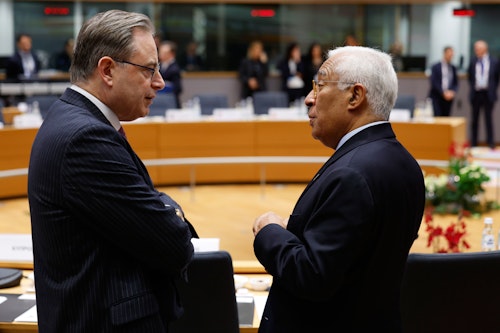
Associated Press.
Slovenia’s PM: ‘We need to have final talks with Russia'
Slovenian Prime Minister Robert Golob said the European Union must engage in “final talks with Russia” if it wants to achieve peace on the continent.
"The fact that we are talking to each other is pretty nice and full of media slogans, but a strong step against peace is only possible today,” Golob told reporters on the sidelines of the European Council.
Golob stressed that the issue goes beyond money, noting that “there are alternatives,” including contributions from each member state. “The frozen assets probably are not enough,” Golob said.
EU leaders discuss migration issues over a breakfast ahead of the summit
Fifteen EU leaders have held a sixth informal coordination meeting on “innovative solutions” to address migration, co-chaired by the prime ministers of Italy, Denmark and the Netherlands, a diplomatic source said.
Other EU leaders took part in the talks, including from Austria, Bulgaria, Cyprus, Croatia, Germany, Greece, Poland, Czech Republic, Latvia, Malta, Hungary and Sweden.
European Commission President Ursula von der Leyen also attended the meeting.
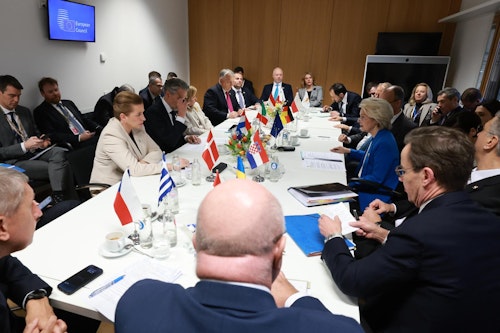
Credits photo: European Union
Ireland’s Taoiseach backs use of immobilised assets as a matter of sovereignty
"We're very much in favour of the utilisation of the immobilised assets or the raising of a clapper alone against the assets to finance Ukraine over the next two years,” Irish Taoiseach Micheál Martin told reporters on the sidelines of the European Council summit.
Ireland argues that there needs to be deterrence against countries like Russia that violate the UN Charter, undermine the sovereignty of other nations, and then destroy those countries, their civil infrastructure, and their energy infrastructure.
Reparations loan would prove Europe 'means business', Estonia PM says
Estonian Prime Minister Kristen Michal told reporters that the reparations loan is needed to uphold the principle that "the aggressor must pay" and show Ukraine and the rest of the world that "Europe is up to (the) task".
"If we can make a decision with the frozen assets, that also has the indication to our partners that we mean business," he added.
If leaders can't agree on a solution today, "then we have to continue tomorrow" and if they fail then, "then day after that, because I have a calendar free for that," Michal said. "But jokes aside, I would say that for Europe this is like make it or break it moment, because everybody's looking at us with the frozen assets."
Leaders are also set to discuss the proposal for the bloc's next multi-annual financial framework, which will cover the 2028-2034 period. Earlier this year, the European Commission put forward a nearly €2 trillion proposal.
Michal said the "first proposal is quite good", notably because it includes more money for defence.
"What needs more attention probably is the eastern border because (the) eastern region has been affected by Russian warfare," he argued.
Michal and the leaders of other so-called frontline states attended the first-of-its-kind Eastern Flank Summit on Tuesday where they called for the "prioritisation" of EU funds towards the Eastern Flank Watch flagship project in the Commission's Defence Readiness 2030 Roadmap.
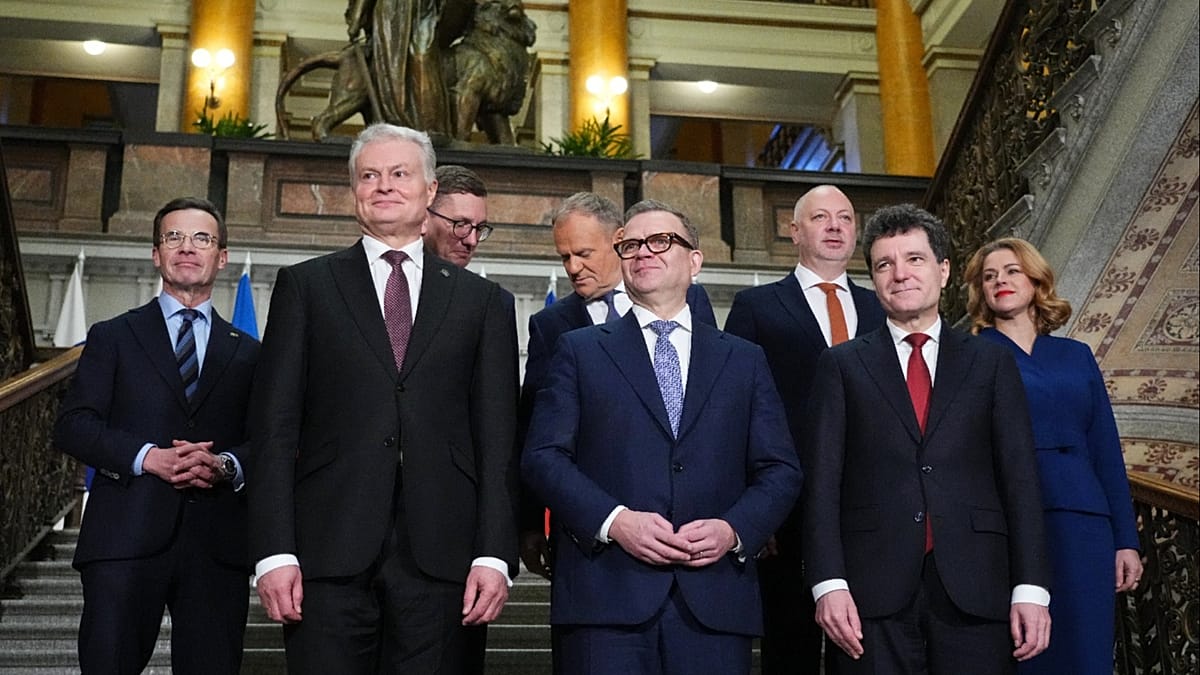
Eastern flank must be prioritised for EU defence funding, leaders say
The Eastern Flank Watch is one of four flagship projects pitched by the European Commission to boost Europe’s defence, but EU leaders have yet to endorse the p…
Bart De Wever says he won't give up but is open to compromises
Belgian Prime Minister Bart De Wever has skipped arrivals because he spoke earlier today at the Belgian parliament. Belgium, the prime custodian of the immobilised Russian assets, has vehemently opposed the reparations loan for Ukraine and has asked for sweeping guarantees in exchange.
"I won't give up," he said this morning, according to Belgian media. "I haven't seen any text yet that would persuade me to change Belgium's position. I hope to see it today, but so far, it hasn't arrived."
De Wever noted he was open to making "compromises" with the other leaders but not when it comes to "the financial security of Europe and Belgium".
If the reparations loan is eventually approved, that will be a "shame", he said. "But if it's completely mutualised and sealed off for our country, then we'll jump into the abyss along with all the Europeans and hope the parachute will hold us," he added.
De Wever insisted his preference is to issue fresh debt at the EU level, possibly by invoking Article 122, which only requires a qualified majority and is designed for economic emergencies. But the European Commission believes using Article 122 to issue common debt and bypass unanimity could be illegal.
Netherlands to guarantee €14 billion for Ukraine's reparations loan
The Netherlands will guarantee up to €14 billion if EU leaders agree to use frozen Russian assets for a reparations loan, Dutch Prime Minister Dick Schoof told reporters upon arriving at the summit on Thursday.
"We have to share the risks with each other. I think that is a fair objection on the part of the Belgians," he said, adding: "I think it's important that we figure it out today".
The proposal on the table would see member states take on guarantees proportionally. Germany, the EU's largest economy, would likely guarantee up to €52 billion.
On the Mercosur, which is not officially on the agenda but is likely to occupy most of the discussion leaders will have on competitiveness, Schoof said the trade agreement as it stands is "decent".
He added that farmers' concerns over the treaty are "important" but that "a number of additional measures have been taken" to assuage them.
Latvian PM Silina wants to show Russia a ‘red flag’ with a deal on frozen assets
Latvian Prime Minister Evika Siliņa told reporters that the best way to support Ukraine would be to reach an agreement on Russia’s immobilised assets, adding that such a move would allow Europe to send a strong message to Moscow.
“The first and the best option is to use frozen assets, to show a strategic move," Siliņa said. "Europe is able to decide and to show a red flag to Russia.”
She said that many of the legal aspects of this approach have already been resolved and would not affect Member States’ debt levels. While acknowledging Belgium’s legal concerns, the Latvian prime minister stressed that a political decision is now required.
“Belgium is surely in a very sensitive situation, but it is also a question of political will, not just legal aspects," she said. But we are politicians, we are the ones who are making rules as well so we have to figure out how we decide on that, not just for Ukraine, but for Europe as well.“
Silina said another option to support Ukraine would be joint borrowing. But to agree on this, unanimity is needed, and Hungary is not supporting the idea.
Reparations loan won't be approved without Belgium, says Costa
António Costa, the president of the European Council and chair of today's crucial summit, has underlined that no decision on the reparations loan shall be taken without Belgian consent. Belgium holds €185 billion in immobilised Russian assets and fears being liable for the unprecedented scheme.
"I want to commend Belgium and Prime Minister Bart De Wever (for raising) critical legal and technical issues in a very constructive way," Costa said upon arrival.
"We will never leave this Council without a final decision (for Ukraine), and we will never approve the solution that does not ensure all the security for Belgium and the Belgians."
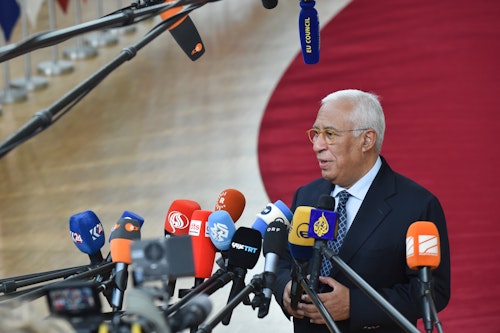
Luxembourg PM: joint EU borrowing is the 'easier' option to fund Ukraine, but strong majority is needed
Financing Ukraine through joint EU borrowing on the financial markets is the “easier” option, but it would require a strong majority—or even unanimity—Luxembourg Prime Minister Luc Frieden told journalists on Thursday ahead of the EU leaders’ summit in Brussels.
“It is easier because it does not jeopardise financial stability of the Eurozone, and it does not entails complex technical discussions," Frieden said.
The Prime Minister said the use of immobilised assets, which is the other option on the table, is more complex. "It was never done before and it raises complex legal issues."
There are €210 billion of Russian sovereign assets in Europe, of which €185 billion are held in Euroclear, a Brussels-based depository. But Belgium has firmly resisted the initiative, fearing it would face Russia's retaliation and multi-billion-euro losses at court. The country has demanded that other member states provide strong guarantees.
“We have to find a group of countries which share the risks” if Russia launches a court case to claim the assets at the end of the war or once sanctions are lifted, the Luxembourg PM said.
The asset's option would require a qualified majority to be used among the 27 member states.
European Parliament ready to 'move urgently' on Ukraine financing: Metsola
European Parliament President Roberta Metsola told reporters on Thursday morning as she arrived at the summit that "the most important thing we can do today is to stand with all our full unity behind President Zelenskyy and Ukraine."
"That means we need to resolve the financing issue here. The European Parliament is willing to cooperate on all fronts. We are ready to go and move urgently if a decision is taken on the reparations loan."
"But make no mistake, we are in a no-choice scenario if we want to help Ukraine, if we want to reassure that Europe's security is guaranteed. Then we need to find a solution today on the financing of Ukraine," Metsola added.
Bart De Wever, the protagonist of the summit, skips arrivals
Belgian Prime Minister Bart De Wever will not take part in the arrival doorsteps at today’s crucial EU summit, as he addressed the Belgian parliament earlier today.
This is a big disappointment for reporters: De Wever is the chief opponent of the reparations loan for Ukraine and is always generous in his remarks to the media. In October, his intervention in the morning set the tone for the remainder of the day.
Orbán: the issue of frozen assets is 'dead'
Hungarian Prime Minister Viktor Orbán said there is enough support in the European Council to block the idea of using Russia’s frozen assets to support Ukraine.
“I think the issue of frozen assets is dead. Last night, I saw that there are enough opposing countries here to form a blocking minority. So I think this is a dead issue.”
Orbán added that leaders should re-examine the issue of financing Ukraine. He will refuse to accept a joint borrowing for Ukraine even if Hungary gets an opt-out from the financial guarantees.
“For Hungary, the path of financing Ukraine from a joint loan is absolutely not possible, but beyond the legal limits, I would not agree with it. I think that we should not finance war, but peace. What I am trying to achieve here today is that we take steps towards peace, not war. “
Orbán reiterated his previous statement that using Russia’s sovereign assets would equal a declaration of war.
“The plan is to take the seized property of one of the parties at war and give it to the other side," he said. "This is nothing more than a declaration of war.”
Orbán also said he supported farmers protesting in Brussels. The Mercosur free trade agreement with Latin-American countries “would kill farmers," he added. 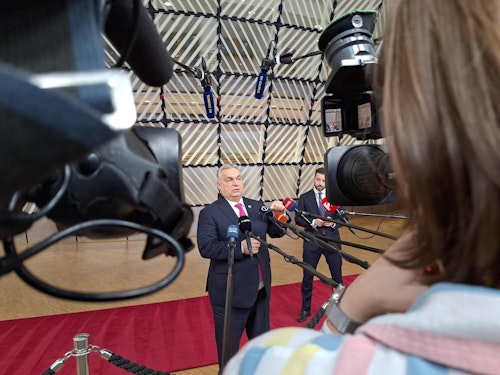
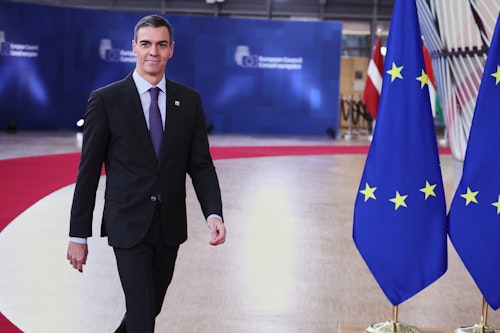
Pedro Sánchez calls for coherence on Ukraine and Gaza
Pedro Sánchez has urged the EU to be "coherent" in their response to Ukraine and Gaza, warning about "double standards" accusations from other countries.
Upon arrival, he outlined three key principles: unity, coherence and action. "We have to make one decision, be it one or the other, about the support needed for the Ukrainian people at this critical time," Sánchez said.
The Spanish leader also urged the EU to sign the free trade deal with Mercosur, which is close to falling apart after Italy sided with France and requested a delay in the vote.
"This agreement is one of many for Europe to gain geo-political and geo-economic weight," he said. "Europe must be open to this type of commercial agreement."
"It would be very frustrating if Europe failed to reach a deal with Mercosur," he added.
Associated Press.
Swedish PM: we can find 'technical solutions' to help Belgium
Swedish Prime Minister Ulf Kristersson told journalists on Thursday that finding an agreement on using Russian immobilised assets to finance Ukraine is the better option on the table.
EU leaders are meeting in Brussels on Thursday and Friday to decide how to raise at least €90 billion to meet Ukraine's financial and military needs for 2026 and 2027.
Two options are currently on the table: The first is to use frozen Russian Central Bank assets to create a zero-interest loan for Ukraine, which Kyiv would repay only if Russia later pays war reparations.
The second option would entail the EU collectively raising funds by borrowing on the financial markets, following a model similar to that adopted during the COVID-19 pandemic.
Kristersson said he wasn’t hopeful about the second option as it requires unanimity to be approved. However, he urged the EU to find ways to satisfy Belgium, which holds the majority of the assets.
"Everyone understands that the country that has 90% of the assets must be involved in such a solution. That is why I believe and hope that we can find technical solutions to issues that Belgium is still raising", Kristersson said.
"We’re not there yet, so I won’t be announcing any victory on this issue until much later this evening", the Prime Minister added.
'We have to be tough', says Lithuania’s President on Russian immobilised assets
Lithuania’s President Gitanas Nauseda reiterated the country’s continued support to Ukraine, saying now is the moment for the European Union “to be tough”. “This is not the time to hesitate, we have to touch untouchables like Gazprom and Lukoil because only those bold decisions will make an impact in Russia’s economy,” Nauseda told reporters ahead of today’s European council summit.
He said the decision will have a significant impact on the Russian economy, which is already in bad shape.
The Lithuanian President said the country welcomed the European Commission's proposal for a risk-sharing mechanism to support Belgium, which hosts the bank holding the Russian immobilised assets, Euroclear.
"Lithuania understands the situation of Belgium and some other member states affected. We are ready to participate in risk-sharing mechanisms that countries will step in, so that they should not be punished for their actions,” Nauseda added.
EU-Mercosur trade deal is of 'enormous importance', says von der Leyen
Let's go back to Ursula von der Leyen for a moment. Upon her arrival, the president of the European Commission also spoke about the EU-Mercosur free trade agreement, which is close to collapsing after Italian Prime Minister Giorgia Meloni sided with France to request a delay in the vote. If the vote doesn't happen this week, von der Leyen won't be able to fly to Brazil to sign the text.
"We have to get rid of our over-dependencies. This is only possible through a network of free-trade agreements," von der Leyen told reporters. "And therefore, Mercosur plays a central role in our trade agreements. It is potentially a market of 700 million consumers, like-minded countries that want free trade together."
"It is of enormous importance that we get the greenlight for Mercosur and that we can complete the signature for Mercosur," she added.
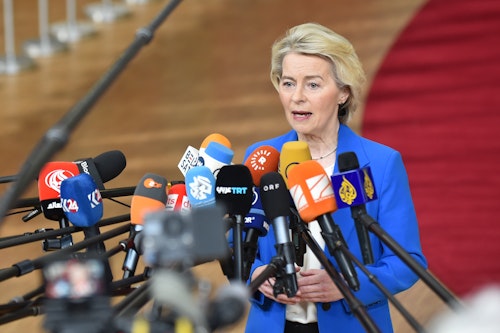
'Large support' for reparations loan in Council, Costa says
European Council President António Costa said upon arriving at the summit that leaders will not leave "without a final decision to ensure the financial needs for Ukraine for 2026, 2027".
He added that there is "large support" in the Council for the reparations loan.
"To put in motion this decision is crucial to increase the pressure on Russia", he also said, and put Ukraine in the "best conditions" for peace talks.
Belgium won't be outvoted on reparations loan, Kaja Kallas promises
High Representative Kaja Kallas has promised that Belgium, the prime custodian of the Russian assets, won't be outvoted on the reparations loan.
"Many member states have said that Belgian consent is very important, so I don't think we are going to move without Belgium being comfortable," Kallas said upon arrival at the summit.
Kallas argued that if the reparations loan becomes law, it will remove the pressure from Belgium because it will become a European-wide solution and the EU, as a whole, will be responsible for it.
"It is the most viable option right now on the table; we need to work with that, as we have tried other things before," Kallas said. "I really hope we get this over the finish line."
Asked if the reparations loan could imperil the US-led peace talks, the High Representative said that the "peace deal is jeopardised by Russia, which hasn't accepted anything". She then urged leaders to find a solution this week, warning that Moscow is "banking on us to fail".
Support for Ukraine and an agreement on Mercosur are today’s priorities, says Chancellor Merz
German Chancellor Friedrich Merz maintained his position on the use of frozen Russian assets and said EU leaders need to decide “between today and tomorrow” whether to approve the Mercosur trade deal with the EU and South American countries, including Brazil, Argentina, and Paraguay.
On the frozen Russian assets, Merz said he “doesn’t see any other option” and that it’s possible to “come to a conclusion” during the summit.
"I understand the concerns that some member states have, especially with the Belgian government, but I hope that we will be able to clear them up together and that we also can take a path together from this European Union, to show a sign of strength and determination towards Russia,” Merz told reporters.
On Mercosur, a trade deal that has been in the making for the past 25 years, the EU is facing resistance from France and Italy, which could block it.
“It is time to make a decision. If the European Union wants to remain credible in the trade policy of the world, then decisions must be made now,” Merz said.
"And the decision can only be that Europe agrees and that the Commission President and the Council President tomorrow travel to South America and sign this agreement,” he added, saying he's "confident" the agreement will succeed.
'Our decision to make,' Tusk said on reparation loan
In a very short doorstep statement upon arriving at the summit, Polish Prime Minister Donald Tusk told reporters that the reparations loan to Ukraine will be resolved “either today or tomorrow".
“This is our decision to make,” the former Council President said.
The Polish government strongly supports the loan for Ukraine, which is a European proposal to use frozen Russian assets to finance Ukraine's war effort, and it will be the hottest topic on the table when EU leaders meet today.
Now we have a simple choice: either money today, or blood tomorrow. I’m not talking about Ukraine only, I’m talking about Europe. This is our decision to make. And only ours. All European leaders must finally rise to the challenge.
— Donald Tusk (@donaldtusk) December 18, 2025
Ukraine needs the means to survive this war, Luxembourg Prime Minister tells Euronews
“We need to give Ukraine the means to survive this war, borders cannot be changed by force," Luxembourg Prime Minister Luc Frieden told Euronews’ flagship programme Europe Today.
European leaders are gathering today and tomorrow in Brussels to discuss the most urgent issues to solve before the end of the year, including how to finance Ukraine from the beginning of 2026.
There are two main ways being considered to raise the EU’s €90 billion share to provide Ukraine with financing for the next two years.
The first would be to use frozen Russian Central Bank assets to create a zero-interest loan for Ukraine, which Kyiv would only repay if Russia later pays war reparations. The second would involve the EU jointly borrowing money on financial markets, similar to the approach used during the COVID-19 pandemic.
“We will find a solution, we have two options on the table," Frieden said. The use of frozen assets, the prime minister said, is "complex but we can find a way to make it work”.
There are €210 billion of Russian sovereign assets in the EU, of which €185 billion are held in Euroclear, a Brussels-based depository.
Belgium has demanded other member states provide strong guarantees.
“We have to find a group of countries which share the risks” in the scenario in which Russia launches a court case to claim the assets at the end of the war or once sanctions are lifted.
“We need to be united because the US might not be there with us in the future," the Prime Minister pointed out, referring to Washington's gradual disengagement in supporting Ukraine in its war against Russia.
Mercosur: 'We need to stick with what we agreed with other countries,' Luxembourg PM tells Euronews
The European Union should honour the commitments it has made to its Mercosur partners, Luxembourg Prime Minister Luc Frieden told Euronews’ flagship programme Europe Today.
Addressing farmers’ concerns over the trade deal, the prime minister said these issues “can be solved domestically,” stressing the importance of ensuring the agreement does not fail, amid several EU countries expressing reservations over the deal.
'We won't leave without a solution for Ukraine,' says Ursula von der Leyen
Ursula von der Leyen has arrived at the EU summit with a clear-cut message: "We have to find a solution today," she said. "We won't leave the European Council without a solution for the funding for Ukraine for the next two years."
The president of the European Commission has proposed two options: the reparations loans, based on the immobilised Russian assets, and joint debt, backed by the EU budget. Though she has previously advocated in favour of the reparations loan, today she made no special distinction, saying simply that "the most important part" is to raise €90 billion to meet Ukraine's needs for 2026 and 2027.
Von der Leyen said that it is "absolutely understandable" that Belgium, the prime custodian of the Russian assets, has concerns about the reparations loan. "I totally support Belgium that they insisting on having their worries and concerns accommodated, and we’re working day and night with Belgium," she said, thanking Belgian Prime Minister Bart De Wever for his "engagement".
"If we take the reparations loan, the risk has to be shared by all of us. This is a matter of solidarity and a core principle of the European Union," she said.
Reparations loan for Ukraine: Who's in favour and who's against?
As we wait for EU leaders to make their way into the summit, we want to get you up to speed on the main issue: the reparations loan.
Under the scheme, the financial institutions that hold the immobilised assets of the Russian Central Bank would transfer their cash balances to the Commission, which would then issue a zero-interest loan to Ukraine. Kyiv would be asked to repay only after Moscow ends its war and compensates for the damage its invasion has wrought. Moscow would then be able to recover its money, completing the cycle.
While the proposal has been met with public enthusiasm by some leaders, like Germany's Friedrich Merz and Denmark's Mette Frederiksen, it faces staunch opposition from others, such as Belgium's Bart De Wever and Hungary's Viktor Orbán.
We break down who's in favour and who's against.
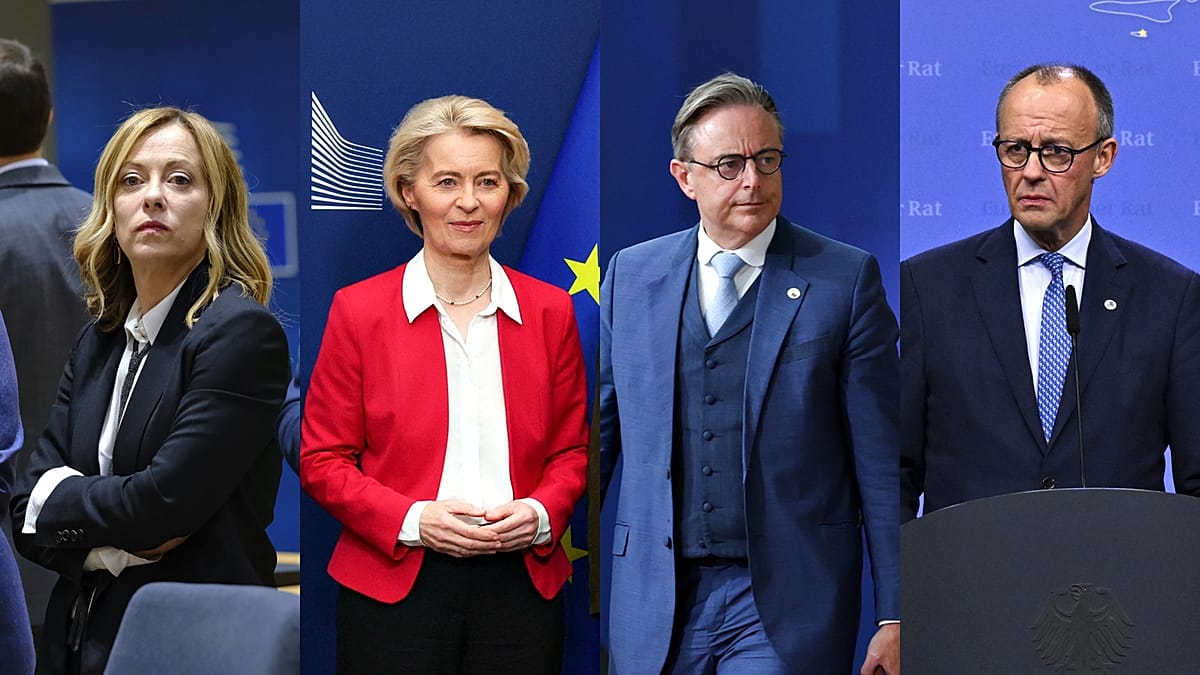
Reparations loan for Ukraine: Who’s in favour and who’s against?
The European Union’s bold attempt to issue a reparations loan to Ukraine using immobilised Russian assets has sharply divided the bloc’s key leaders. Ahead of…